HRVFantech HEROHVI 2505381
Fantech HERO 150H
Heat recovery ventilator (HRV). Moves heat between the outgoing and incoming air, so winter fresh air arrives warmer. Moisture goes out with the stale air.
- ENERGY STAR (Canada)
About $1,246Equipment only, at SupplyHouse, October 2026. Installed cost is more.
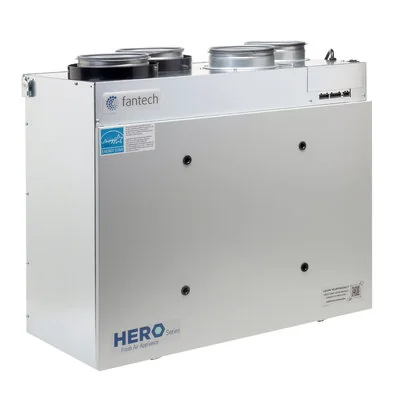
Photo shows the Fantech HERO family. Photo: Fantech
- 140 cfmFresh air at 0.5 in. of duct pressure
- 150 cfmAt 0.4 in., HVI’s rating point
- 75–80%Heat recovery at 32°F (SRE)
- 60–150 WFan power at 32°F
At a glance
- In its favour: HVI-certified (HVI 2505381)Its airflow and efficiency were tested to the Home Ventilating Institute’s standard.
- Plain fact: 150 cfm at 0.4 in., 140 cfm at 0.5 in. of duct pressureCertified fresh air delivered, at HVI’s headline rating point and at the higher pressure many real ducts run at.
- Not stated by the maker: No Fantech CO2 control documented for the HEROIts D+ and D− input holds maximum speed while closed, so a CO2 relay there should work electrically. Fantech doesn’t document it: ask first. (Our August review listed Fantech’s CO2 sensor accessory for this family; Fantech’s manuals don’t show it wired to a HERO.)
- In its favour: Humidity control documented
- Plain fact: How it handles frost in very cold weatherInternal recirculation defrost ('WinterGuard'). It starts when the outdoor temperature falls below 23 °F (−5 °C) and does not depressurize the home.
Certifications
HVI certified
HVI 2505381
The Home Ventilating Institute tested its airflow and heat recovery. The certified numbers on this page come from its directory. Find HVI 2505381 in HVI’s directory
ENERGY STAR (Canada)
Listed as HERO 150H
On Natural Resources Canada’s ENERGY STAR list for HRVs and ERVs, which sets minimums for heat recovery in cold weather and for fan power. ENERGY STAR certifies HRVs and ERVs only in Canada. NRCan’s ENERGY STAR list (search the model number) (checked October 19, 2026)
Would it cover your home?
Tell it who sleeps in each bedroom. It’s checked against the 800 ppm goal the same way the app checks a unit an installer quotes.
Certified airflow
How much fresh air it delivers as the ducts push back. More duct pressure, less air: that’s why the installer’s duct design matters as much as the unit.
Every certified point
| Duct pressure (in. w.g.) | Fresh air delivered (cfm) |
|---|---|
| 0.1 | 176 |
| 0.2 | 167 |
| 0.3 | 159 |
| 0.4 | 150 |
| 0.5 | 140 |
| 0.6 | 129 |
| 0.7 | 121 |
| 0.8 | 110 |
| 0.9 | 100 |
| 1.0 | 87 |
| 1.2 | 64 |
- Lowest steady airflow (maker)
- 50 cfm
- Highest airflow (maker)
- 150 cfm
Heat recovery
Sensible recovery (SRE) is the share of heat kept in winter, after the fan’s own heat is taken out. Higher is warmer incoming air for the same airflow.
| Outdoors | Airflow | SRE | Fan power | cfm per watt |
|---|---|---|---|---|
| 32°F (0°C) | 72 cfm | 80% SRE | 60 W | 1.2 |
| 32°F (0°C) | 93 cfm | 78% SRE | 77 W | 1.2 |
| 32°F (0°C) | 150 cfm | 75% SRE | 150 W | 1 |
| -13°F (-25°C) | 72 cfm | 63% SRE | 105 W | 0.6 |
- Plain fact: Keeps 75–80% of the heat at 32°FAcross the airflows HVI tested.
- In its favour: Tested at −13°F too: 63% SREHVI’s very-cold test point, useful in cold climates.
Turning up on CO2
A CO2 control can switch it to a higher speed when the bedroom needs air, then back. HouseExhale’s setting: up at 750 ppm, back at 650, never above 800.
- Not stated by the maker: No Fantech CO2 control documented for the HEROIts D+ and D− input holds maximum speed while closed, so a CO2 relay there should work electrically. Fantech doesn’t document it: ask first. (Our August review listed Fantech’s CO2 sensor accessory for this family; Fantech’s manuals don’t show it wired to a HERO.)
What Fantech documents
- Not stated by the maker: No CO2 control documented for its home unitsIts CO2RT-R (99315) is sold with its commercial units, and its switch-point range isn’t published.
- In its favour: HERO: a dry-contact input holds maximum speed while closedTerminals D+ and D− (meant for a dehumidistat). A CO2 relay there should work electrically; Fantech doesn’t document it, and defrost comes first.
- Worth knowing: Never connect 120 V to its control terminalsFantech’s manual says so; a CO2 relay needs its own 24-volt supply.
- Plain fact: Flex: its boost timers run 20 to 60 minutesA timer input runs its time and stops, rather than staying high.
Four ways to make it turn up by itself
A CO2 control on its high-speed inputAsk your installer
HERO’s D+/D− input holds maximum speed while closed. Undocumented for CO2: your installer confirms.
A night scheduleAsk your installer
A timer on its timer or D+/D− input, or its wall control’s settings.
Its maker’s CO2 controlAsk your maker first
Fantech’s CO2RT-R exists, but Fantech doesn’t show it wired to a HERO or Flex. Ask Fantech first.
Your monitor and a smart-home relayAsk your maker first
A dry-contact relay on D+/D−. Not documented by Fantech.
Installing it
The maker’s facts an installer plans around. Your installer confirms them for your home.
- Power
- 120 V, single phase, 1.4 A, 180 W. A 3-foot plug-in power cord with a 3-prong plug.Scope: 1.4 A max also on Fantech's HERO page and in the June 2025 brochure
- Duct connections
- 6 in (152 mm) round metal duct collars with rubber seals, all on top (top ports)Scope: '6" top ports' also in the SupplyHouse and Sylvane listing titles
- Size
- Height 24 7/8 in (626 mm) × width 27 7/8 in (707 mm) × depth 13 3/8 in (341 mm). The spec sheet adds 23 in as an unlabeled fourth size and recommends 14 in (355 mm) clear in front to slide the core out.Scope: clearance from the 2022 spec sheet
- Weight
- 51 lb (23 kg)Scope: SupplyHouse also says 51 lb (23.2 kg) including core; the 2022 spec sheet says 52 lb (see notes)
- Mounting
- On a wall with the included speed bracket (wall bracket kit 428546), or hung from the ceiling joists with chains, hook screws and springs (chain kit 404261), kept level. For the 150H the IOM says to move the vibration isolators to the holes shown, and the unit stands upright against the wall.Scope: kit numbers from the 2020 HERO manual parts list (https://www.appliancefactoryparts.com/content/pdfs/291072-1.pdf)
- Drain line
- Yes: as an HRV it needs a drain line for condensation. The IOM's drain step is 'only necessary for HRV products', and a drain tube comes in the box for HRVs.Scope: family IOM (p. 14); the 150H is the HRV ('Fresh Air Appliance - HRV') per its spec sheet
- Cold weather
- Internal recirculation defrost ('WinterGuard'). It starts when the outdoor temperature falls below 23 °F (−5 °C) and does not depressurize the home.
- Balancing the airflow
- Manual balancing using integrated pressure taps
- Ducts
- Dedicated or simplified central-HVAC integrations per manual
- In the box
- Casing, collars, terminals, power cord, long wall bracket, washers, wood screws, chains (4), springs (4), hook screws (4), chain screws, sheet-metal screws, drain tube (HRV) and a balancing chart. No wall control.Scope: HERO family box list; SupplyHouse also lists the wall-mounting speed bracket, removable screw terminal and core
Controls
- Comes with: None: wall controls are not in the box. Balancing must be done with the ECO-Touch control (range 90-210 cfm).
- Wall controls sold: The spec sheet lists ECO-TOUCH-IAQ, ECO-Feel, EDF7, EDF1R, RTS-W, RTS2, RTS5 and MDEH1. Fantech's current controls page lists ECO-Touch IAQ (414727), ECO-Feel IAQ (414729), EDF3, EDF8, RTS2, RTS4, RTS5, RTS-W (414920) and MDEH-1.
- Boost: Timers that run maximum speed for a set time: RTS2 20 min; RTS4 and RTS5 20/40/60 min; RTS-W wireless 20/40/60 min, which pairs only through ECO-Touch IAQ.
- App or smart home: None listed on Fantech's residential controls page
- High-speed input: D+/D− dehumidistat dry contact: shorted, the unit runs at MAX speed until the contact opens (held). T+/T− timer; S+/S− remote off. Never connect 120 V to these contacts.
- Humidity control
- Documented
- Bathroom boost
- Documented
- Works without the internet
- Documented
Owning it
- Equipment price
- $1,246.23 at SupplyHouse, October 17, 2026In stock (44). No sale or 'was' price shown.
- $1,110 at Sylvane, October 17, 2026Read from the page's metadata. The product section did not load in the fetch, so stock and sale status are unknown; confirm on the page. Free shipping advertised.
- Rebates
- Federal tax credits ended for work after 2025. Some states and utilities still pay toward an HRV or ERV: rebates by state.
- Filters
- Type: Two washable electrostatic panel filters, plus a MERV 8 supply-side filter (the spec sheet calls it both 'integrated' and 'optional')
- MERV: Electrostatic panels are MERV 3 (IOM, product card). Optional MERV 8, MERV 13 and HEPA kits.
- Size: Panels 7.87 × 11.81 × 0.125 in (200 × 300 × 3 mm); MERV 8 supply filter 5.77 × 12.09 × 1.75 in (146.5 × 307 × 44.5 mm)
- Part: MERV 8 kit 428526; MERV 13 kit 428548 (pack of 2); HEPA kit 428551 (pack of 2); electrostatic 428520
- How often: Clean the electrostatic filters, and check or replace the MERV 8 filter, every 3 months or when dirty (2020 manual). The 2026 IOM says check filters every 3 months and the core every 6 months.
- Warranty
- Core: Limited lifetime on the counterflow core
- Parts: 5 years (the IOM: electrical components and damper motor)
- Motor: 7 years on fan motors
- Conditions: Limited warranty, from the date of purchase (2020 manual). Void after improper installation, unauthorized work, or connecting appliances such as clothes dryers or range hoods to the HRV.
- Sound
- Not stated in the sources we found
- Availability
- Active: on Fantech's current HERO page and online catalogue; in stock at SupplyHouse, which says it replaces the VHR150R
Not known yet
What we couldn’t confirm from the maker or HVI. Ask the installer, and get it in writing with the quote.
- A CO2 control documented for this exact model
- How loud it is
Where the maker’s own documents disagree
- Current: SupplyHouse lists '120V, 3 amps'. Fantech's 2022 spec sheet, HERO page and 2025 brochure all say 1.4 A.
- Weight: 51 lb in the June 2025 brochure and at SupplyHouse; 52 lb (23.42 kg) including core on the 2022 spec sheet. A 2019 Systemair brochure gives a 59 lb shipping weight (
- Filter wording: the spec sheet's feature list says 'Integrated MERV 8' but its filter section calls the MERV 8 optional. Fantech's 150H product card says MERV 3 is the default, with optional MERV 8 and MERV 13.
Other sizes and similar units
Other Fantech HERO sizes
Fantech HERO 100E
ERV · HVI 2005335
95 cfm at 0.5 in.
Fantech HERO 140E
ERV · HVI 2005472
133 cfm at 0.5 in.
Fantech HERO 200H
HRV · HVI 2505147
195 cfm at 0.5 in.
Other HRVs with similar airflow
Lifebreath 155MAX
HRV · HVI 2505085
123 cfm at 0.5 in.
Lifebreath 205MAX
HRV · HVI 2505460
159 cfm at 0.5 in.
Aldes H120-TQG
HRV · HVI 2505395
97 cfm at 0.5 in.
Sources
- Home Ventilating Institute: Section III HRV/ERV complete product listing
- Home Ventilating Institute: Section III HRV/ERV airflow ratings
- Home Ventilating Institute: Section III HRV/ERV energy ratings
- Fantech: HERO fresh-air appliance family
- Radon PDS: HERO 150H observed retail listing
- Fantech: HERO Series HRV/ERV installation manual, document 428486-003 (revised 2026-05-19)
- Natural Resources Canada: ENERGY STAR heat/energy recovery ventilators: searchable product list (216 models on October 19, 2026)
- Fantech HERO 150H HRV Specification Sheet, product 99401, item 444777, rev 2022-06-06 (Appliance Factory Parts copy)
- Fantech Online Catalogue product card: HERO® 150H HRV, item 99401 (created 07-17-25)
- Fantech HERO Series (HRV) Installation and Operation Manual 428486, rev 2020-11-02, with parts list (Appliance Factory Parts copy)
- Fantech 'Fresh Air is Our Super Power' ATMO and HERO brochure, June 2025 (Sylvane copy)
- Fantech HERO150H HERO 150H Heat Recovery Ventilator (SupplyHouse)
- Sylvane: listing
- Fantech: CO2RT-R specification sheet
- Fantech: Flex 100H manual
Certified airflow and efficiency from the HVI directory (exported September 23, 2026), joined to this exact model by its HVI number. The maker’s facts from our review of August 31, 2026 and our research of October 17, 2026. This is product information, not a design: your installer confirms the ducts, room-by-room airflow and controls, then measures the airflow after install.
Thinking about a system?
Measure your bedrooms first. When installers quote, the app checks the exact unit they propose, this one or any HVI-certified unit, against what your bedrooms need.