HRVs and ERVs are both balanced ventilation systems: they bring in fresh outdoor air, send stale indoor air out, and recover much of the heat along the way. The difference is moisture. An HRV transfers only heat between the two airstreams, while an ERV transfers heat and some moisture, which matters most where winters are very dry or summers are humid.
How balanced ventilation works
A balanced system has two fans. One pulls outdoor air in and the other exhausts stale indoor air at roughly the same rate, so the house is neither pushed nor pulled. Both airstreams are filtered and pass through a core, a heat exchanger where heat moves from the warmer stream to the cooler one.
In winter, the outgoing warm air preheats the incoming cold air, so you get fresh air without heating all of it from scratch. In summer, when your home is cooler than outside, the exchange runs the other way and incoming air arrives a little cooler.
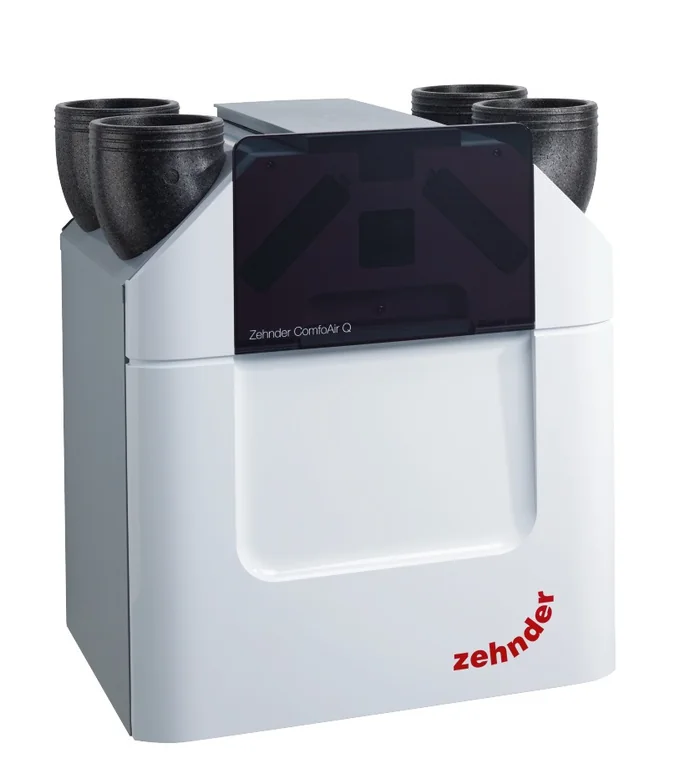 Zehnder ComfoAir Q350HRV or ERV
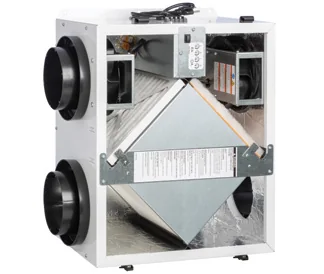 RenewAire EV Premium MERV, panel open to show the core
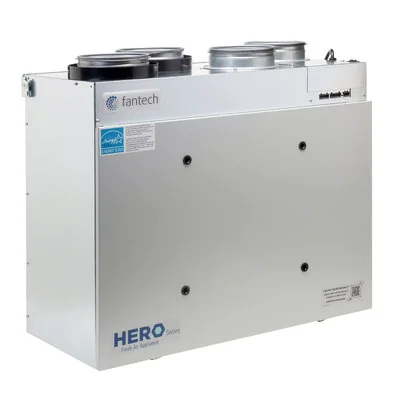 Fantech HEROHRV or ERV family
The one real difference: moisture
An HRV (heat recovery ventilator) exchanges heat only. An ERV (energy recovery ventilator) exchanges heat and a portion of the water vapor. In practice, an ERV hands some indoor moisture back to the incoming air in winter and keeps some outdoor humidity out in summer.
Neither one is a humidifier, a dehumidifier, or an air conditioner. Building Science Corporation points out that ERVs do not dry out a home in summer or cool it, so homes in humid climates still rely on air conditioning or a dehumidifier for that job.
| HRV | ERV | |
|---|---|---|
| What the core transfers | Heat only | Heat and some moisture |
| Winter in a cold, dry climate | Brings in dry air, so indoor humidity can drop | Returns some outgoing moisture, so humidity drops less |
| Summer in a humid climate | Brings in outdoor humidity | Brings in less outdoor humidity than an HRV |
| Often a fit for | Mild climates; small, tight homes with many people and extra winter moisture | Humid climates; cold, dry climates where winter air gets uncomfortably dry |
In cold climates, either type also needs to be set up to handle frost and condensation, often with a defrost mode and sometimes a condensate drain. Ask what the model you're quoted requires.
The rule of thumb, and its exceptions
The traditional advice, as Building Science Corporation summarizes manufacturer guidance, is HRVs for cold or dry climates and ERVs for humid ones. The same document then adds two exceptions. In a cold climate, an ERV in a small, tight house with many occupants might not remove enough moisture in winter. An HRV in a large, leakier house with few occupants could leave indoor humidity uncomfortably low.
Some building scientists now lean toward ERVs for most homes. Allison Bailes of Energy Vanguard argues that most people in most places are better served by an ERV, and that HRVs make the most sense in mild climates or in crowded, airtight homes that benefit from extra winter drying.
Cold, dry climates like Colorado's
The Denver area and the rest of the Front Range are classed as a cold climate with a dry moisture regime (IECC zone 5B) in the Department of Energy's Building America climate guide. Cold outdoor air holds little water, so once it's warmed indoors its relative humidity falls sharply. Every bit of ventilation brings more of that dry air in.
That is the case for an ERV in places like this. Natural Resources Canada notes that where winters are extremely dry, an ERV recovers some of the moisture and helps keep humidity comfortable. The Building America Solution Center makes a similar point: in colder climates where winter air is often uncomfortably dry, an ERV can help retain moisture and may improve comfort. If you already run a humidifier all winter, mention it to any installer you talk to.
The exception still applies here. A small, tight home with several people, lots of cooking and showers, and condensation on the windows may not need the moisture an ERV holds on to. That's a judgment about your specific house, and it's the installer's job to make it with you.
Other US climates in brief
- Humid regions such as the Southeast and Gulf Coast: ERVs are the usual suggestion because they bring in less outdoor moisture. You'll still need air conditioning or a dehumidifier to control indoor humidity.
- Mild marine climates such as the Pacific Northwest: HRVs remain popular, since winters there are neither very cold nor very dry.
- Very cold northern climates: the same dry-winter logic as Colorado applies, and frost protection becomes more important.
What should decide it for your home
- Your climate in both summer and winter.
- How many people live in the home compared with its size.
- Whether winter air already feels too dry (you run a humidifier) or too wet (windows fog or drip).
- Whether you have central air conditioning, and how humid your summers get.
Ask each installer which type they'd choose and why. A good answer refers to your house and household, not only a brand they like. Ask, too, how the unit handles frost and condensation during your coldest weeks.
Before you choose either
A ventilation system is one option, not the starting point. Measuring your bedroom air for a few nights and trying a free change, such as sleeping with the door open, tells you whether you need a system at all. If you do, those readings from HouseExhale give an installer something concrete to design around.
This week: Gather what an installer needs to choose
- Write down your home's rough floor area, number of bedrooms, and how many people usually sleep there.
- For three mornings, note your bedroom CO2 reading, plus the humidity reading if your monitor shows one.
- Note whether you run a humidifier in winter or see condensation on the inside of windows on cold mornings.
- Bring these notes to any installer visit and ask which type they would choose for your home, and why.
Sources
- Building Science Corporation: Info-611: Balanced ventilation systems (HRVs and ERVs)
- Building America Solution Center (PNNL): Whole house ventilation strategies for existing homes
- Natural Resources Canada: Heat recovery ventilators (2012)
- Energy Vanguard: Why you probably need an ERV, not an HRV (2021)
- U.S. DOE Building America: Guide to determining climate regions by county