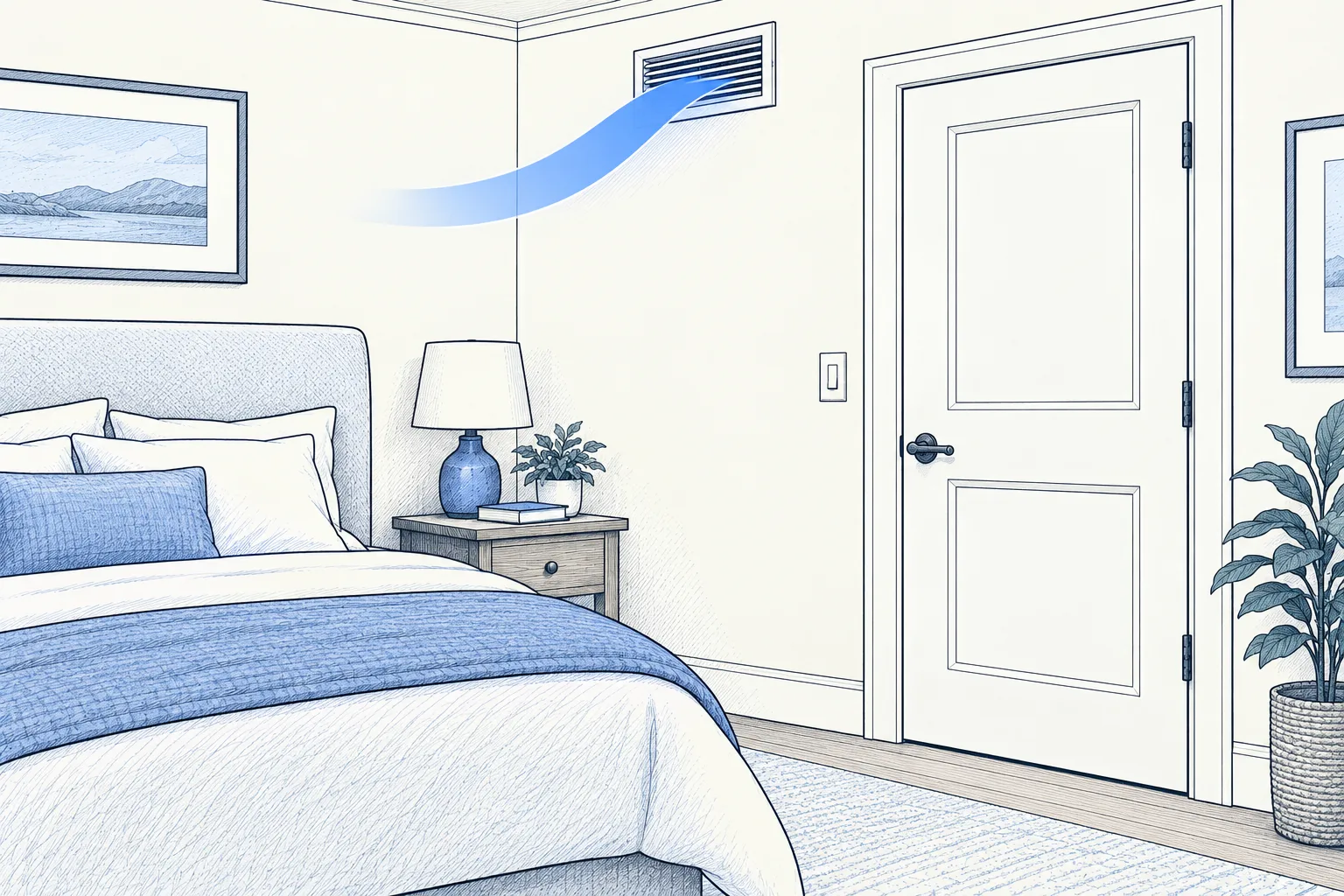
The setting: switch to high at 750 ppm and back down at 650, or ramp up from 600 to full speed by 750. Never above 800. Keep the system running on its normal speed the rest of the time, so CO2 only ever adds to it.
Plenty of homes already have an HRV or ERV that runs one speed around the clock. A bedroom with two people in it can still climb past the 800 ppm goal on that speed, then sit there all night. Turning the system up at bedtime often fixes it, but few people remember to, and high speed all day is louder and dries the house in winter.
A CO2 control does the remembering. It watches the bedroom and turns the system up when the air builds up, then back down. A night schedule does a simpler version of the same job. This guide covers whether that will work in your home, the four ways to set it up, the numbers to set, and how to check it with your own monitor.
Start here: does high speed reach 800?
A control can't do more than high speed does. So before you buy anything, find out what high speed gets you.
- Measure two usual nights with the system on its normal setting and the bedroom door as you usually have it.
- Then two nights on high, everything else the same. Use the system's highest steady speed. A boost button that runs for 20 minutes and stops won't tell you much.
- Compare. In the HouseExhale app this is the fix called "Turn up your ventilation system", and the app compares the nights for you.
Turning up a system that supplies or pulls air in the bedroom typically lowers overnight CO2 by roughly 40–55% (free fixes has the evidence). In a Belgian study where researchers switched whole-house systems to their high setting, bedrooms averaged about 810 to 860 ppm: close to 800, not comfortably under it.
If high gets you to 800 or less, it's worth making automatic. Read on.
If it doesn't, the bedroom isn't getting enough outdoor air even on high, and no setting will change that. Ask for a balancing check: about 17 cfm of outdoor air per person sleeping there should reach the room on high. Check that the room has a fresh-air supply grille at all, and that air has a way out when the door is shut. Getting a bedroom to 800 has the numbers, and what to do if the bedroom still reads over 800 has the checks.
The whole system turns up, not just the bedroom
Most homes have one ventilator with ducts to every room. A sensor in the bedroom can tell it to speed up, but the extra air is shared out the same way as before: the bedroom gets its own share of the total. If the main bedroom gets a fifth of the supply, getting 34 cfm to two sleepers takes about 170 cfm from the unit. Many home units can't do that, or can't do it quietly.
Two things follow:
- Put the sensor in the bedroom that gets stuffiest. Some systems take several sensors and follow the highest reading.
- A sensor in the return duct or inside the unit sees the whole house mixed together, empty rooms included. In a modelling study of a small apartment, most single-sensor strategies in the shared exhaust did worse than leaving the system on a constant speed when one bedroom sat empty. A bedroom sensor is better. If the duct is your only option, set it lower (about 650 on, 550 off) and check the bedroom with your monitor.
Four ways to make it turn up by itself
| Way | Who sets it up | Works with | Worth knowing |
|---|---|---|---|
| Its maker's CO2 control | An installer | Units whose maker sells one: RenewAire, Zehnder, Lossnay and some S&P models; the CERV2 has one built in. Broan, Lifebreath, Panasonic and Aldes don't sell a true-CO2 one | Check the factory setting: some makers suggest 1,000 ppm or more |
| A CO2 control on its high-speed input | An installer | Units with an input that holds high speed while it's switched on | Some inputs are 20-minute timers; most makers don't document a CO2 relay |
| Your monitor and a smart-home relay | You, if you're comfortable with low-voltage wiring | The same low-voltage high-speed input | An always-on hub; check your manual and warranty first |
| A night schedule | You, or an installer for a timer | Almost any unit, through its control or a timer | Runs high every night, needed or not |
Each control we read about has its own page, with how to set it under 800 and what it's documented with: CO2 controls.
Its maker's CO2 control
The most straightforward choice when your maker sells one, because the maker documents how it connects and how the unit responds. RenewAire's CO2-W wall control switches its units to high above a trip point you can set anywhere from 500 to 1,500 ppm. Zehnder's CO2 sensor connects to its ComfoAir Q units through an Option Box and raises the airflow gradually.
Check what it's set to before you rely on it. Zehnder's control works to hold the room at its setting rather than switching at it, and Zehnder suggests 1,000 ppm; its sensor's built-in controller mode holds 1,050. Ask your installer to use sensor mode with the Option Box set to 700 ppm (3.5 volts). The CERV2's guide recommends 900 to 1,100; set its CO2 setting to 750. On a RenewAire EV Premium, ask for the unit to go back to its normal speed when CO2 drops, not to switch off.
Broan's Overture system says it ventilates when CO2 climbs, but Broan doesn't publish its sensor type or the levels it uses, and one spec sheet lists eCO2, an estimate. Check with your monitor before relying on it.
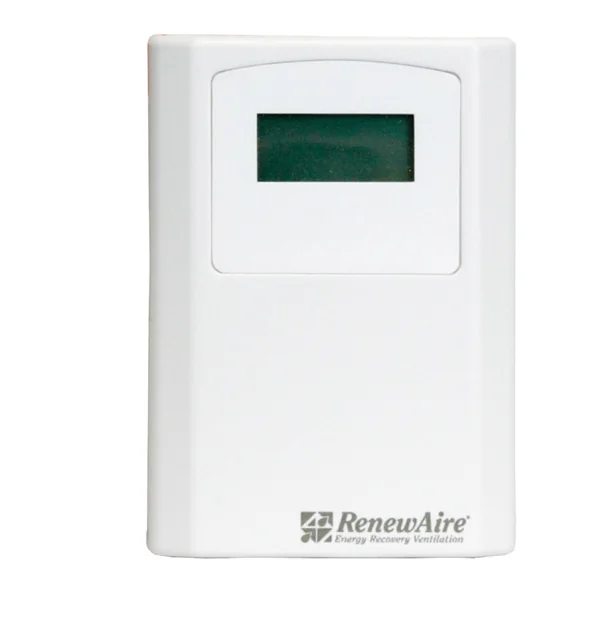 RenewAire CO2-WWall CO2 control
 Zehnder CO2 sensor
A CO2 control on its high-speed input
Many units have a pair of terminals that run them on high while they're joined, meant for a dehumidistat, a timer or a switch. A wall CO2 controller with a built-in switch (a relay) can join them while CO2 is above its setting. On a Fantech HERO, for example, the dehumidistat input holds maximum speed until the contact opens, and Lifebreath documents terminals 2 and 6 for continuous high speed.
Three things to check first:
- Does the input stay on high, or run a timer? A 20-minute boost input runs its time and stops, whatever CO2 does.
- Can the controller's switch point be set to 750? Several commercial ones can be programmed from 500 ppm. A few come set to 800 and only go up from there, and some have a fixed 1,000, which won't do.
- Is it the right input? On a Broan AI unit, use OVR, not VENT: a contact on VENT drops the unit to standby every time it opens, so ventilation would stop whenever the bedroom is fine.
- Is the input low-voltage? Most are. Panasonic's Intelli-Balance 100 boost switch carries 120 volts, which a low-voltage relay isn't made for, and Broan warns that 24 volts on its AI terminal block can ruin the board.
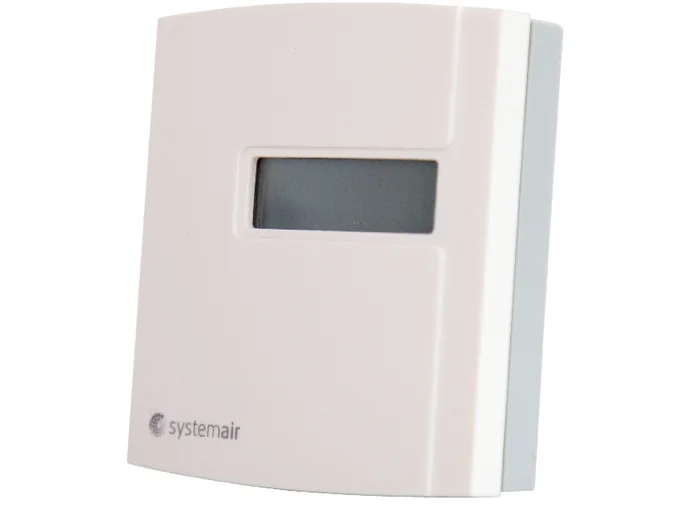 Fantech CO2 sensor 99315Shown with Systemair branding
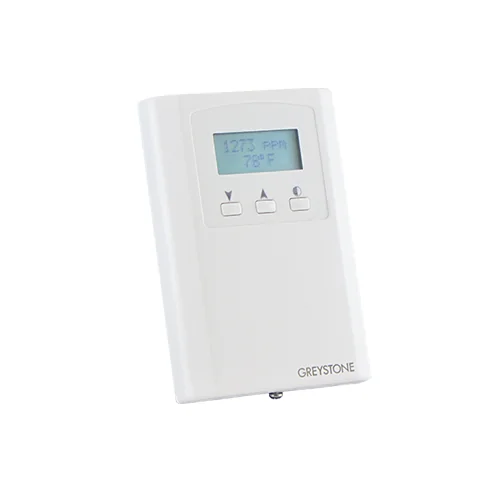 Greystone CD2RMCRoom CO2 transmitter
Most makers don't document this pairing, so it's your installer's call, and worth asking the maker. The CO2 relay controllers we priced in October 2026 cost about $290 to $440, before wiring. Most run on 24 volts, and makers don't document powering one from the unit, so plan on its own small power supply. We didn't find a published price for the whole job.
Your monitor and a smart-home relay
If you run Home Assistant, it can read a CO2 monitor you already own and switch a small relay wired to the unit's high-speed input: on above 750 ppm, staying on at least 15 minutes, and off below 650. It reads Aranet4, SwitchBot Meter Pro CO2, Qingping and INKBIRD monitors over Bluetooth on your own network; an Aranet4 needs firmware 1.2.0 or later with its Smart Home integration turned on. It's the most do-it-yourself of the four.
- Use a true dry-contact relay. The Shelly 1 Gen3 and Zooz ZEN17 are; the Shelly Plus 1PM isn't. The Sonoff MINI-D switches only DC, and some units' inputs are AC.
- Low-voltage inputs only. Switch the unit off at its plug or breaker before you wire anything. Anything at 120 volts is an electrician's job.
- Plan for the hub or the power to stop. The unit should simply carry on at its normal speed. Some relays switch back on after a power cut, so set yours to come back off, or to switch itself off after a while. Unplug the hub once and check.
- Read your manual and warranty first. No maker documents this.
There's also a no-wiring version: SwitchBot's app can have a SwitchBot Bot press the unit's boost button when the Meter Pro CO2 passes a level. It needs a SwitchBot hub, and the monitor on USB power so it reports often enough. A boost button usually runs a timer rather than holding high speed.
A night schedule
No sensor at all: the system runs high from a little before bedtime until you get up. Use the unit's own schedule if its control has one, or a timer on its high-speed input. Some smart thermostats run a ventilator too: ecobee can run one a set number of minutes an hour, and Aprilaire's can follow a timer. None we found switches it by a measured CO2 level. Starting 30 to 60 minutes before bed gives the room a head start on the climb. It runs high whether or not anyone's home, and on dry winter or smoky nights too, but there's nothing to calibrate and nothing to drift.
The numbers to set: 800 or lower
- A control that switches: high at 750 ppm, back to normal at 650, and staying on at least 15 minutes at a time so it doesn't click up and down all night.
- A control that ramps: start rising at 600, full speed by 750.
- A control that holds a setting (Zehnder's works this way): 700.
- A sensor in the return duct: about 650 on and 550 off, then check the bedroom.
Why not just set 800? The goal is an average across the whole night, including the climb after bedtime, and good home CO2 sensors are rated within about 55 to 90 ppm at 800 (how accurate monitors are). In a Danish study, a bedroom fan that came on at about 900 ppm still left the nights averaging 835. Starting at 750 leaves room for both. No study has yet tested a control against an 800 night average, so these are HouseExhale's numbers built on that evidence, and your own nights are the real test.
Some controls can't go this low: one European unit's top setting can't go below 1,000. If yours can't, use its lowest setting with a night schedule, and let your nights tell you whether it's enough.
Keep it running on low
Let CO2 add high speed on top of the normal speed. Don't let it switch the system off when the bedroom is fine.
- Natural Resources Canada advises running an HRV on low continuously, year-round.
- Model building codes allow a whole-house system to run part-time only if it runs at least a quarter of every four hours, at a higher rate to make up for it, and they require a switch you can turn it off with. A bedroom sensor can't promise that: during an empty day it might never come on.
- ASHRAE's home ventilation standard allows ventilation that varies, within rules about averages.
This means the control adds fresh air at night rather than saving energy. That's the point: it's for the bedroom, not the bill.
Quiet enough to sleep through
A control turns the fan up at the moment you're trying to sleep. In a study of 299 Dutch homes, almost all occupants ran their system on a lower setting than recommended, and the researchers put the unused high setting down to noise. In UK studies, people complained of fans speeding up at night on a humidity sensor, and some switched their systems off.
- Test high speed at bedtime with the door shut before you set up a control.
- Aim for a speed you can't hear change. Passive House sets 25 dB(A) for living spaces, and UK guidance 30 dB(A) for bedrooms.
- If high is too loud, use a quieter middle speed and fix the airflow to the room instead. A control that ramps gently is easier to sleep through than one that jumps.
Where the sensor goes, and keeping it honest
- In the bedroom that gets stuffiest, at about head height, at least an arm's length from the bed, and away from windows, doors and the supply grille.
- True CO2 only. The sensor that drives the system must measure CO2 itself (NDIR or photoacoustic). Readings labelled eCO2 or CO2eq are estimates from other gases.
- Watch self-calibration. Many sensors treat their lowest reading of the week as fresh outdoor air. In a bedroom that never airs out, that teaches them to read low, so the system turns up late. Turn it off where you can, or give the sensor fresh air now and then.
- Check it against your monitor. Put your monitor beside the control's sensor for a night. Near 750 they should agree within about 100 ppm. Check again each season. Can I trust my CO2 monitor? has the outdoor check.
By brand
What each maker documents, checked on October 17, 2026. "Not documented" means we didn't find it in the maker's own manuals, not that it can't work. Your unit's manual has the final word. Each unit in our list of HRVs and ERVs has a page with what its maker documents for CO2 control.
| Brand | Its own CO2 control | An input a CO2 control could use | Set to 800 or lower? |
|---|---|---|---|
| Aldes | None | High speed on terminals 1 and 4 in its 2018 family manual (the EK80's own manual uses a jumper on 3 and 4); Aldes warns against speed controls, dehumidistats or timers other than its own | Depends on the control |
| AprilAire | Not found; its thermostats ventilate by a timer, not CO2 | Not checked in its ventilator manuals | Depends on the control |
| Broan, Venmar, vänEE | None that measures true CO2. Overture says it ventilates on CO2 but publishes no sensor type or levels | AI series: OVR and 12V take "any dry contact"; whether it holds high isn't stated. Not VENT: open, it drops the unit to standby. Older models: OL and OC | Depends on the control |
| Build Equinox CERV2 | Built in | Not needed | Yes, on its touchscreen; its guide recommends 900 to 1,100 |
| Fantech | Not documented for its home units (its CO2RT-R is sold for commercial ones) | HERO: dehumidistat input (D+/D−) holds maximum speed while closed | Depends on the control |
| Lifebreath | None | Terminals 2 (ON) and 6 (HI) hold high speed; its METRO manual allows third-party dry contacts there | Depends on the control |
| Mitsubishi Lossnay | PZ-70CS sensors; fan speed steps up with CO2 | 0–10 V input sets four speeds | Not published for US models; elsewhere 300 to 2,000, low and high at least 300 apart (450 and 750 works) |
| Panasonic | None | Elite and BalancedHome: dry-contact boost (BST); the manual doesn't say if it holds while closed. Intelli-Balance 100: boost switch is 120 V | Depends on the control |
| RenewAire | CO2-W (wall) or CO2-D (duct), for EV90, EV130, EV200, EV Premium and EV Premium+ | EV Premium: 24VAC to HIGH holds high speed. EV90 and EV130: unpowered controls only, and the contact may switch the unit on and off | Yes: 500 to 1,500 ppm |
| S&P | SCO2-W, listed for TRC and TRPLe units | TRe: not stated | SCO2-W: 600 to 2,000 |
| Zehnder ComfoAir Q | CO2 sensor through the Option Box; it holds the room at a setting | Option Box 0–10 V inputs; the Q unit has no terminals of its own | Yes, in sensor mode (3.5 V is 700). Not in controller mode (1,050) |
Units sold under an HVAC maker's name. We couldn't read these makers' own manuals, but the HVI certification directory lists their units with exactly the same ratings as another maker's, which suggests the same equipment underneath: Carrier and Bryant HRVs and ERVs match Broan AI units, Lennox Healthy Climate matches Lifebreath, Trane and American Standard Envirowise matches RenewAire, and Honeywell VNT5150 and VNT5200 and Daikin Clean Comfort match Fantech units. Use that maker's row as a lead, and check that your manual's terminal names match before anything is wired.
Ask your installer
Put your numbers in the request, so you both start from the same place:
- Which terminals on our unit can call for high speed, and does that input stay on high while it's closed, or run a timer?
- Can a CO2 control there be set to switch to high at 750 ppm and back at 650, or ramp from 600 to full by 750? What's its factory setting?
- On high, how much outdoor air reaches the main bedroom, in cfm? We're aiming for about 17 cfm per person sleeping there.
- How loud is high speed in the bedroom with the door shut?
- Will it stay on its normal speed the rest of the time, and go back to normal if the control fails?
- Does adding the control affect the warranty?
- What will parts and labor cost, and will you set the levels and test that high speed comes on before you leave?
Prove it with your monitor
Once it turns up by itself, sleep three ordinary nights with it running: same monitor spot, same people, same door and window as your usual nights. If those nights average 800 or less, it works. If the control ran high all night and the room still averaged over 800, the room needs more air, not a lower setting.
In the HouseExhale app, Your system → Ventilation walks through it: your unit, two nights on high, the ways that fit your brand, and three nights to prove it.
Smoke, dry winters and filters
- Smoke: more outdoor air means more smoke on smoky nights. Turn the system back to its normal speed, or off as its manual says, while outdoor air is poor. Ventilation and wildfire smoke covers filters and when to switch off.
- Dry winters: more outdoor air in cold weather dries the house. In the Danish study, people sleeping with more ventilation reported drier mouths and skin. An ERV keeps more of the indoor moisture than an HRV; HRV vs ERV explains.
- Filters: clogged filters cut the airflow on every speed, high included. Clean or change them as the manual says.
This week: See what high speed can do
- Log two usual nights with your system on its normal setting, and the door and window as you usually have them.
- Before the next night, stand in the bedroom with the door shut and switch the system to its highest steady speed. If it's loud enough to keep you awake, note it.
- Sleep two nights on high, everything else the same. Use a steady speed, not a 20-minute boost button.
- Compare. If the nights on high average 800 or less, it's worth making automatic. If they don't, ask for a balancing check before you buy a control.
Sources
- Strøm-Tejsen et al. (2014), ROOMVENT 2014: The effect of CO2 controlled bedroom ventilation on sleep and next-day performance
- Fan et al. (2023), Science of the Total Environment 884: A single-blind field intervention study of whether increased bedroom ventilation improves sleep quality
- Akimoto et al. (2025), ASHRAE 1837-RP: New research on bedroom ventilation and sleep quality suggests that building standards should be revisited
- Guyot, Sherman & Walker (2018), Energy and Buildings 165: Smart ventilation energy and indoor air quality performance in residential buildings: a review
- Rojas (2022), AIVC Conference: Assessing demand-controlled ventilation strategies based on one CO2 sensor
- Natural Resources Canada: Heat recovery ventilators (2012)
- Oregon Building Codes Division (2021): Balanced mechanical whole-house ventilation strategies (IRC Table M1505.4.3(2), intermittent operation)
- ASHRAE: Addendum c to Standard 62.2-2016 (variable mechanical ventilation, Section 4.5)
- Boerstra et al.: Residential ventilation system performance, outcomes of a field study in the Netherlands (AIVC)
- Dengel & Swainson, NHBC Foundation NF52 (2013): Assessment of MVHR systems and air quality in zero carbon homes
- Zero Carbon Hub (2016): Ventilation in new homes
- iPHA / Passive House Institute (2021): Fact sheet on indoor air quality
- UK Health and Safety Executive: Using CO2 monitors
- Amphenol Advanced Sensors (2018): Guidelines for CO2 sensor selection (automatic baseline calibration)
- RenewAire: CO2 sensor wiring supplement (Feb 2026)
- RenewAire: EV Premium installation manual (Nov 2025)
- RenewAire: EV130/EV200 installation manual (Apr 2024)
- RenewAire: CO2-W / CO2-D specification sheet
- Zehnder: Option Box installer's manual (CO2 settings advice)
- Zehnder: CO2 sensor installation manual (sensor and controller modes)
- Broan-NuTone: AI series user and installer manual (VENT and OVR inputs)
- Broan-NuTone: HRV150S/HRV190S/ERV180S installation guide (OL and OC)
- Broan-NuTone: Overture Smart Plug manual
- HomeControls: Overture wall control specifications (lists eCO2)
- Lifebreath: METRO installation, operation and maintenance manual (dry contacts 2 and 6)
- Lifebreath: residential HRV installation manual
- HVI: certified HRV and ERV directory (export of September 23, 2026)
- Fantech: HERO series installation manual (May 2026)
- Fantech: CO2RT-R specification sheet
- Panasonic: Intelli-Balance 100 (FV-10VEC2) installation manual (Jan 2024; boost switch rated 120 V)
- Panasonic: Intelli-Balance Elite installation manual (Jun 2025)
- Build Equinox: CERV2 touchscreen guide (recommended setting 900–1,100 ppm)
- Build Equinox: new CERV2 features (Feb 2022)
- Mitsubishi Electric (US): CITY MULTI Lossnay booklet (May 2022)
- Mitsubishi Electric NZ: Lossnay CO2 sensors (Nov 2025)
- Aldes: residential HRV/ERV installation manual (2018)
- S&P: Total recovery ventilators brochure (Jul 2022)
- Maico: WS 120 Trio CO2 operating instructions (CO2 sensor settings)
- City of Scottsdale (2023): Whole-house mechanical ventilation options, 2021 IRC M1505 (manual override and intermittent operation)
- SupplyHouse: Fantech CO2RT-R CO2 sensor with relay (price, October 2026)
- Ferguson Home: S&P SCO2-W CO2 control (price, October 2026)
- Honeywell: C7232 CO2 sensors/controllers (relay at 800, off at 700)
- Amphenol Telaire: Ventostat 8000-R series user instructions (factory 800 ppm relay)
- Greystone: CDD4 datasheet (relay setpoint 500–2,000 ppm)
- Kele: CD-AW-LCD CO2 sensor with relay (price, October 2026)
- e-controls: Greystone CDD4B101R (price, October 2026)
- Home Assistant: Aranet integration
- Home Assistant: SwitchBot integration (Meter Pro CO2)
- Home Assistant: Qingping integration
- Home Assistant: INKBIRD integration
- Shelly: Shelly 1 Gen3 (potential-free contact)
- Shelly: the difference between Shelly Plus 1 and Shelly Plus 1PM
- Zooz: ZEN17 universal relay manual (power-loss behaviour, auto-off)
- SwitchBot support: using the Meter Pro CO2's CO2 value to trigger a Bot
- SONOFF: MINI-D documentation (DC loads only)
- Aprilaire: 8910/8910W/8920W thermostat specification sheet (ventilation control)
- Home Assistant: ecobee integration (ventilator minimum runtime)