ERVZehnder ComfoAir Q350HVI 2005163
Zehnder ComfoAir Q350 ERV
Energy recovery ventilator (ERV). Moves heat and some moisture between the outgoing and incoming air, so dry winter air keeps more of the home’s humidity and humid summer air brings in less.
- Passive House
About $5,180Equipment only, at Mainstream Corporation (Zehnroom Ventilation Kits, Berthoud, CO), October 2026. Installed cost is more.
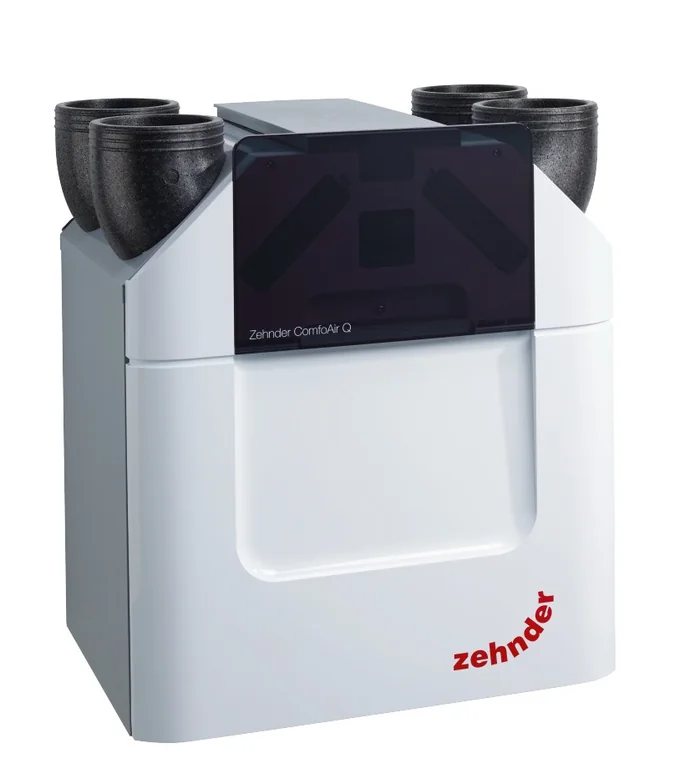
Photo shows the Zehnder ComfoAir Q350 family. Photo: Zehnder
- 201 cfmFresh air at 0.5 in. of duct pressure
- 201 cfmAt 0.4 in., HVI’s rating point
- 76–83%Heat recovery at 32°F (SRE)
- 28–90 WFan power at 32°F
At a glance
- In its favour: HVI-certified (HVI 2005163)Its airflow and efficiency were tested to the Home Ventilating Institute’s standard.
- Plain fact: 201 cfm at 0.4 in., 201 cfm at 0.5 in. of duct pressureCertified fresh air delivered, at HVI’s headline rating point and at the higher pressure many real ducts run at.
- In its favour: Zehnder’s own CO2 sensor works through its Option BoxAirflow rises gradually as CO2 rises. Set it to 700 ppm (3.5 V in sensor mode), not the 1,000 Zehnder suggests.
- In its favour: Humidity control documented
- Plain fact: How it handles frost in very cold weatherAutomatic frost protection. An optional adaptive electric pre-heater (9656-00) warms incoming outdoor air to keep the core from freezing, and Zehnder recommends it for cold climates. Frost protection can also cut supply airflow, which leaves the house slightly out of balance unless the fireplace setting is on. No source gives the temperature at which it starts.
Certifications
HVI certified
HVI 2005163
The Home Ventilating Institute tested its airflow and heat recovery. The certified numbers on this page come from its directory. Find HVI 2005163 in HVI’s directory
ENERGY STAR (Canada)
Not on the list
Not on Natural Resources Canada’s ENERGY STAR list when we checked. ENERGY STAR certifies HRVs and ERVs only in Canada, so a unit sold in the U.S. may never have been submitted; that isn’t a sign it’s less efficient. Its HVI numbers show its heat recovery and fan power. NRCan’s ENERGY STAR list (checked October 19, 2026)
Passive House
Component 1006vs03
The Passive House Institute certified it as a ventilation component for very airtight homes. Its Passive House listing
Would it cover your home?
Tell it who sleeps in each bedroom. It’s checked against the 800 ppm goal the same way the app checks a unit an installer quotes.
Certified airflow
How much fresh air it delivers as the ducts push back. More duct pressure, less air: that’s why the installer’s duct design matters as much as the unit.
Every certified point
| Duct pressure (in. w.g.) | Fresh air delivered (cfm) |
|---|---|
| 0.1 | 201 |
| 0.2 | 201 |
| 0.3 | 201 |
| 0.4 | 201 |
| 0.5 | 201 |
| 0.6 | 201 |
| 0.7 | 201 |
| 0.8 | 201 |
| 0.9 | 201 |
| 1.0 | 201 |
- Lowest steady airflow (maker)
- 41 cfm
- Highest airflow (maker)
- 201 cfm
Heat and moisture recovery
Sensible recovery (SRE) is the share of heat kept in winter, after the fan’s own heat is taken out; total recovery (TRE) counts moisture too, in summer.
| Outdoors | Airflow | Recovery | Fan power | cfm per watt |
|---|---|---|---|---|
| 32°F (0°C) | 95 cfm | 83% SRE | 28 W | 3.3 |
| 32°F (0°C) | 138 cfm | 80% SRE | 47 W | 2.9 |
| 32°F (0°C) | 184 cfm | 76% SRE | 90 W | 2 |
| 95°F (35°C), cooling | 97 cfm | 73% TRE | 30 W | – |
| 95°F (35°C), cooling | 138 cfm | 67% TRE | 56 W | – |
- Plain fact: Keeps 76–83% of the heat at 32°FAcross the airflows HVI tested.
- Not stated by the maker: No very-cold (−13°F) test in the HVI directory
- Plain fact: Total recovery in summer: 67–73% at 95°FThe share of heat and moisture kept out on a hot, humid day.
Turning up on CO2
A CO2 control can switch it to a higher speed when the bedroom needs air, then back. HouseExhale’s setting: up at 750 ppm, back at 650, never above 800.
- In its favour: Zehnder’s own CO2 sensor works through its Option BoxAirflow rises gradually as CO2 rises. Set it to 700 ppm (3.5 V in sensor mode), not the 1,000 Zehnder suggests.
Documented control setups for this unit
Zehnder CO2 Sensor 0-10V67 + Zehnder Option BoxWorks directly with this system
Airflow rises as CO2 rises. Each bedroom sensor sends a proportional request through an independently configured Option Box input. The Q350 compares requests and responds to the highest demand within the commissioned airflow limits.
Set it to 700 ppm.
Greystone Energy Systems CD2RMC + Zehnder Option BoxProfessional setup option
Airflow rises as CO2 rises. The third-party sensor's 0-10 V output can feed the Option Box, which documents support for sensors within that input range.
Set it to 700 ppm, if it can be set that low: its maker doesn’t publish its range.
Aranet Aranet4 HOME + Open Home Foundation Home Assistant + Zehnder ComfoConnect LAN CDIY smart-home option
Automation changes fan speed. Home Assistant reads Aranet over Bluetooth and writes a Q350 ventilation preset through the community ComfoConnect integration.
Set it to 750 ppm.
What Zehnder (ComfoAir) documents
- In its favour: Its own CO2 sensor, through the Option Box (ComfoAir Q)Airflow rises gradually as CO2 rises. Up to four sensors; the highest reading decides.
- Worth knowing: Set it to 700, in sensor modeIt works to hold the room at its setting, so aim under 800. Zehnder suggests 1,000, and the sensor’s own controller mode holds 1,050; in sensor mode, 3.5 volts on the Option Box is 700.
- Worth knowing: The sensor’s light stays green up to 1,200 ppmGo by your monitor’s number, not the light.
- Plain fact: The Q unit has no boost terminals of its ownIts switch and sensor inputs are on the Option Box.
Four ways to make it turn up by itself
Its maker’s CO2 controlMade for it
Zehnder’s 0–10 V CO2 sensor and Option Box, in sensor mode with the setting at 700 ppm (3.5 V).
A night scheduleAsk your installer
Ask whether its control or the ComfoControl app can run a higher speed at night.
A CO2 control on its high-speed inputAsk your maker first
A third-party sensor on the Option Box’s 0–10 V input isn’t documented by Zehnder.
Your monitor and a smart-home relayAsk your maker first
Home Assistant’s ComfoConnect integration is unofficial and marked legacy.
Installing it
The maker’s facts an installer plans around. Your installer confirms them for your home.
- Power
- 240 V, 60 Hz. 208 V also works but gives about 7% less maximum airflow. Maximum draw is 180 W / 1.42 A without the pre-heater and 1,850 W / 10 A with it. It needs a dedicated 240 V / 60 Hz / 15 A circuit, and the rough-in guide gives the receptacle as NEMA 6-15. The installer manual lists a 2.5 m power cord in the box.Scope: circuit and receptacle from the Electrical rough-in requirements guide (https://zehnderamerica.com/wp-content/uploads/2024/08/Electrical-Rough-In-Requirements.pdf); cord from the installer manual
- Duct connections
- Four round duct connections of 160 mm (6.3 in), which turn freely and sit on the top or the side. The installer manual gives 160 mm inside and 190 mm outside.Scope: same for the Q350 HRV and ERV
- Size
- Height 32 in (809 mm), 34 in (850 mm) with connectors; width 29 in (725 mm), 31 in (790 mm) overall; depth 22 in (570 mm), 22.8 in / 23.4 in (580 mm / 595 mm) total.Scope: same for the Q350 HRV and ERV
- Weight
- 110 lb (50 kg)Scope: same for the Q350 HRV and ERV; the installer manual also gives 50 kg for the whole Q range
- Mounting
- Wall-mounted on the supplied bracket, on a wall of at least 200 kg/m². Floor-mounted on the optional Zehnder base or frame, which is also for lighter walls. The connections come set up for the right side and can be changed to the left. Ceiling hanging is not mentioned.Scope: same for the Q350 HRV and ERV
- Drain line
- The installer manual says the ERV (enthalpy) version makes no condensation, so it needs no drain siphon: both drain connections are sealed with the caps supplied. Zehnder's System Reference Guide instead says a condensate drain is 'required for HRV's and recommended for ERV's' (see notes).
- Cold weather
- Automatic frost protection. An optional adaptive electric pre-heater (9656-00) warms incoming outdoor air to keep the core from freezing, and Zehnder recommends it for cold climates. Frost protection can also cut supply airflow, which leaves the house slightly out of balance unless the fireplace setting is on. No source gives the temperature at which it starts.
- Balancing the airflow
- Constant-flow/pressure monitoring and guided commissioning
- Service space
- 1 m front
- Ducts
- Dedicated Zehnder distribution preferred; engineered integration required
- In the box
- Unit, mounting bracket, power cord, documentation and dust cover. The ERV version comes with two drain sealing caps in place of the HRV's drain adapter set. No wall control is included.
Controls
- Comes with: Built-in display on the unit: speed, scheduler, settings, error messages and a start-up wizard. No wall control is in the box.
- Wall controls sold: ComfoSense C67 (9617-00); ComfoSwitch C67 (6918-00 in the spec list, 9618-00 in the control-options table); bathroom boost switch (9556-00); Option Box (9620-00); humidity sensor (9256-01); ComfoSplitter (9647-00), needed with more than four components
- Boost: BOOST (preset 3) from the display or a control, with a timer that returns the unit to normal (the manual's example is 40 min). A manual airflow change reverts after the next schedule step or at most two hours. The bathroom boost switch is a low-voltage momentary rocker wired to the Option Box. Its run-on timer defaults to 30 minutes (FIXED), or MIRROR runs as long as the switch was on, per the October 17 CO2 research.
- App or smart home: ComfoControl app through the ComfoConnect LAN C gateway (6919-00 in the spec list, 9619-00 in the control-options table); ComfoConnect KNX C (9655-00) for building systems
- High-speed input: The Q unit has no boost terminals of its own. The bathroom-switch input (momentary, low voltage, never 110 V) and four 0-10 V inputs are on the Option Box, which mounts near the unit.
- Humidity control
- Documented
- Bathroom boost
- Documented
- Works without the internet
- Documented
- CO2 inputs
- 0–10 V input, dry-contact input
Owning it
- Equipment price
- $5,180 at Mainstream Corporation (Zehnroom Ventilation Kits, Berthoud, CO), October 17, 2026Base unit without pre-heater; $5,491.00 with the pre-heater (+$311.00). No sale price or stock status shown. Listed as product code 9833-00. Equipment only: filters, controls and ducting are sold separately.
- Rebates
- Federal tax credits ended for work after 2025. Some states and utilities still pay toward an HRV or ERV: rebates by state.
- Filters
- Type: Two panel filters: one on the outdoor (fresh) air side and one on the indoor (extract) air side
- MERV: Outdoor air F7 (MERV 13); extract air G4 (MERV 7-8)
- Part: Filter set G4/F7 9672-00 (2 filters); G4 9671-00; F7 9670-00
- How often: At least every six months (user manual). The display warns 'EXPECT FILTER CHANGE SOON', then 'CHANGE FILTERS NOW'.
- Warranty
- Parts: 24 months after fitting, up to 30 months after manufacture (user manual). Zehnder America's FAQ: all its products sold in North America carry a two-year limited warranty.
- Labor: Not covered: the customer pays to remove and reinstall the unit, including labor and return shipping (FAQ). On-site assembly and disassembly are not covered (user manual).
- Conditions: Claims go by certified mail with proof of purchase date. The warranty is void after improper installation, wiring, maintenance or voltage, or misuse. The user manual adds running without filters, non-Zehnder parts and unauthorized changes. Zehnder repairs or replaces as it decides.
- Sound
- Sound from the unit's casing into the room where it is installed (sound power, ISO 3741): 33.8 dB(A) at 88 cfm up to 52.0 dB(A) at 206 cfm. The reference guide states the same range as 34 dB(A) at 150 m³/h and 25 Pa up to 52 dB(A) at 350 m³/h and 200 Pa. Sound power into the ducts: extract side 35.0 to 51.0 dB(A), supply side 46.0 to 66.0 dB(A). These are sound power ratings, not the loudness heard at a set distance.
- Availability
- Active: listed on Zehnder America's ComfoAir Q page with a current Q350 spec sheet; sold through Mainstream Corporation (Colorado)
Not known yet
What we couldn’t confirm from the maker or HVI. Ask the installer, and get it in writing with the quote.
- What it costs installed where you live
- How much fresh air it delivers while defrosting
Where the maker’s own documents disagree
- Drain conflict. The installer manual (p. 14) says the enthalpy (ERV) exchanger makes no condensation and both drain connections are capped. The System Reference Guide says a condensate drain connection is 'required for HRV's and recommended for ERV's'.
- Voltage conflict. The North American installer manual (2021) lists 230 V ±10%, 50-60 Hz (and 220-240 V~). The spec sheet lists 240 V, 60 Hz with 208 V possible. The spec sheet also has a separate line reading 'Maximum 175 watt' next to the 180 W figure.
- Dimension lines disagree within the spec sheet: one set gives 'Height: with connector 33 in (850 mm)' and 'Width: with connector 30 in (757 mm)'. The Zehnroom listing gives 34 in H × 31 in W × 23.5 in D. The August 31 catalog had 745 W × 850 H × 570 D mm.
Other sizes and similar units
Other Zehnder ComfoAir Q350 sizes
Zehnder ComfoAir Q350 HRV
HRV · HVI 2505023
195 cfm at 0.5 in.
Other ERVs with similar airflow
Broan AI Series B210E75RS
ERV · HVI 2004939
201 cfm at 0.5 in.
Venmar AI Series V210E75RS
ERV · HVI 2005175
201 cfm at 0.5 in.
Panasonic BalancedHome Elite Plus+ 210 (FV-21VEC1S)
ERV · HVI 2005488
210 cfm at 0.5 in.
Sources
- Home Ventilating Institute: Section III HRV/ERV complete product listing
- Home Ventilating Institute: Section III HRV/ERV airflow ratings
- Home Ventilating Institute: Section III HRV/ERV energy ratings
- Zehnder America: ComfoAir Q350/Q450/Q600 manual for the installer
- Mainstream Corporation: ComfoAir Q350 ERV observed retail listing
- Zehnder America: Zehnder ComfoAir H/ERV overview
- Passive House Institute: ComfoAir Q350 ERV certified component 1006vs03
- Zehnder America: ComfoAir Q350 TR technical specification
- Natural Resources Canada: ENERGY STAR heat/energy recovery ventilators: searchable product list (216 models on October 19, 2026)
- ComfoAir Q, Manual for the user (Q350/450/600)
- ComfoAir Q System Reference Guide (Zehnder America)
- Electrical rough-in requirements: quick guide for electricians in North America (Zehnder)
- ComfoAir Q | Zehnder America
- ComfoAir Q350 ERV Unit with optional Pre-Heater (Zehnroom / Mainstream Corporation)
- Zehnder: Option Box installer’s manual (UK)
- Zehnder: CO2 sensor installation manual (ManualsLib copy)
- Zehnder America: CO2 sensor
Certified airflow and efficiency from the HVI directory (exported September 23, 2026), joined to this exact model by its HVI number. The maker’s facts from our review of August 31, 2026 and our research of October 17, 2026. This is product information, not a design: your installer confirms the ducts, room-by-room airflow and controls, then measures the airflow after install.
Thinking about a system?
Measure your bedrooms first. When installers quote, the app checks the exact unit they propose, this one or any HVI-certified unit, against what your bedrooms need.