Smart-home piecesOpen Home Foundation
Home Assistant
Free software on an always-on computer at home. It can read your CO2 monitor and switch a relay at 750 and 650.
The software is free; it needs a computer to run on.
- Switches on your monitor’s readingHow it decides
- Smart-home software that runs at homeWhat it is
- You, with careWho fits it
At a glance
- Plain fact: Switches on your monitor’s reading
- In its favour: Reads Aranet4, SwitchBot, Qingping and AirGradient monitors locallyOver Bluetooth or your own network, with no cloud. INKBIRD has an integration too; CO2 was confirmed for the IAM-T1, not the IAM-T2.
- In its favour: Its Threshold helper switches on and off with a gapSo it can turn a relay on above 750 and off below 650.
- Worth knowing: Needs an always-on computer and a dry-contact relayPlus a check of what happens if the computer stops with the relay closed: it can stay on high.
- Worth knowing: No ventilator maker documents itZehnder’s ComfoConnect integration is unofficial and marked legacy.
Setting it for a bedroom
HouseExhale’s setting: switch up at 750 ppm and back at 650, or ramp from 600 to full by 750. Never above 800.
- Make an automation: relay on above 750 ppm, stays on at least 15 minutes, off below 650.
- Set the relay to stay off after a power cut, or to switch itself off after a while.
- Unplug the hub once with the relay on, and check the unit goes back to its normal speed.
A Danish study ran a bedroom fan from about 900 ppm and the nights still averaged 835, so a control has to start below the goal. Good home CO2 sensors are rated within about 55 to 90 ppm at 800, and the night average includes the climb after bedtime, so 750 on and 650 off leaves room for both. A control in the return duct mixes the bedroom with empty rooms, so it needs lower settings still (about 650 on, 550 off), and your monitor in the bedroom has the final word. These are HouseExhale’s numbers: no study has tested a control against an 800 night average yet.
What it works with
Documented for: Units with a low-voltage input that holds high speed while closed, through a dry-contact relay. No ventilator maker documents it.
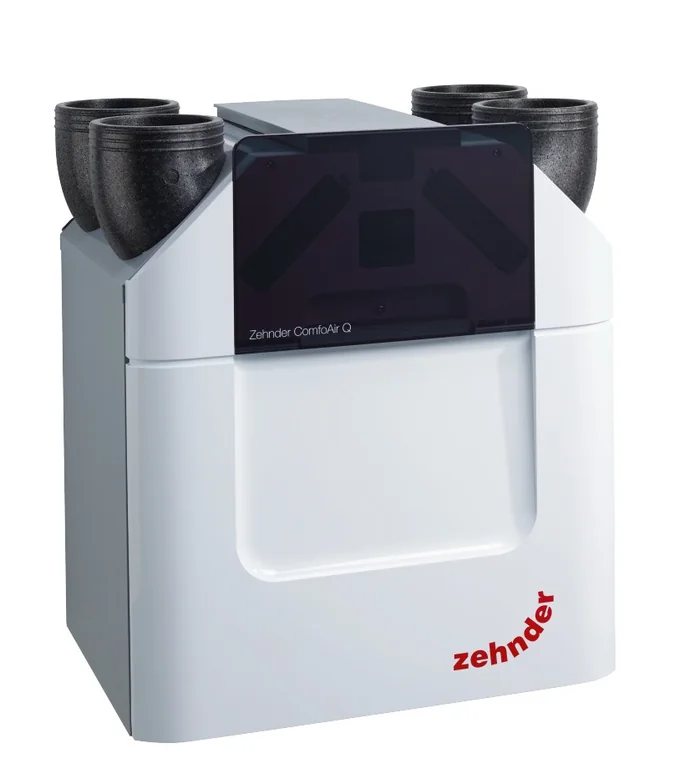
Zehnder ComfoAir Q350 ERV
DIY smart-home option
201 cfm at 0.5 in.
Zehnder ComfoAir Q350 HRV
DIY smart-home option
195 cfm at 0.5 in.
Specs
- Runs on
- A small always-on computer at home
- Monitors it reads
- Aranet4 (firmware 1.2.0+), SwitchBot Meter Pro CO2, Qingping CGP22C and CGDN1, AirGradient ONE; INKBIRD (CO2 confirmed for the IAM-T1)
- Relays
- Shelly, Z-Wave (Zooz), and others
From the maker’s documents, read October 17, 2026. Prices are before tax and shipping and change often.
Smart-home pieces
Use a monitor you already own to switch high speed. Not documented by any ventilator maker: low-voltage inputs only, and check your manual first.
Shelly 1 Gen3
Switches on your monitor’s reading
Wi-Fi relay with a dry contact
SwitchBot Bot, triggered by the Meter Pro CO2
Switches on your monitor’s reading
A button pusher, no wiring
Zooz ZEN17 universal relay
Switches on your monitor’s reading
Z-Wave relay with dry contacts