ERVS&P TReNHVI 2005459
S&P TReN200
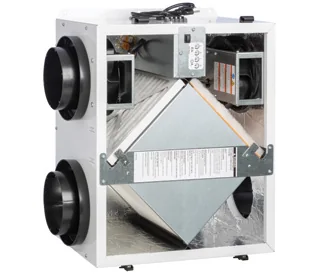
Energy recovery ventilator (ERV). Moves heat and some moisture between the outgoing and incoming air, so dry winter air keeps more of the home’s humidity and humid summer air brings in less.
No S&P document for this exact model was found, so it isn’t drawn.
- 210 cfmFresh air at 0.5 in. of duct pressure
- 218 cfmAt 0.4 in., HVI’s rating point
- 62–81%Heat recovery at 32°F (SRE)
- 19–177 WFan power at 32°F
At a glance
- In its favour: HVI-certified (HVI 2005459)Its airflow and efficiency were tested to the Home Ventilating Institute’s standard.
- Plain fact: 218 cfm at 0.4 in., 210 cfm at 0.5 in. of duct pressureCertified fresh air delivered, at HVI’s headline rating point and at the higher pressure many real ducts run at.
- Not stated by the maker: No S&P CO2 control listed for this modelS&P lists its SCO2-W (600 to 2,000 ppm) for its TRC and TRPLe units. Ask S&P about this one.
Certifications
HVI certified
HVI 2005459
The Home Ventilating Institute tested its airflow and heat recovery. The certified numbers on this page come from its directory. Find HVI 2005459 in HVI’s directory
ENERGY STAR (Canada)
Not on the list
Not on Natural Resources Canada’s ENERGY STAR list when we checked. ENERGY STAR certifies HRVs and ERVs only in Canada, so a unit sold in the U.S. may never have been submitted; that isn’t a sign it’s less efficient. Its HVI numbers show its heat recovery and fan power. NRCan’s ENERGY STAR list (checked October 19, 2026)
Would it cover your home?
Tell it who sleeps in each bedroom. It’s checked against the 800 ppm goal the same way the app checks a unit an installer quotes.
Certified airflow
How much fresh air it delivers as the ducts push back. More duct pressure, less air: that’s why the installer’s duct design matters as much as the unit.
Every certified point
| Duct pressure (in. w.g.) | Fresh air delivered (cfm) |
|---|---|
| 0.1 | 242 |
| 0.2 | 233 |
| 0.3 | 227 |
| 0.4 | 218 |
| 0.5 | 210 |
| 0.6 | 203 |
| 0.7 | 195 |
| 0.8 | 186 |
| 0.9 | 180 |
| 1.0 | 172 |
- Lowest steady airflow (maker)
- Not stated in the review’s sources
- Highest airflow (maker)
- Not stated in the review’s sources
Heat and moisture recovery
Sensible recovery (SRE) is the share of heat kept in winter, after the fan’s own heat is taken out; total recovery (TRE) counts moisture too, in summer.
| Outdoors | Airflow | Recovery | Fan power | cfm per watt |
|---|---|---|---|---|
| 32°F (0°C) | 51 cfm | 81% SRE | 19 W | 2.6 |
| 32°F (0°C) | 102 cfm | 73% SRE | 40 W | 2.5 |
| 32°F (0°C) | 150 cfm | 68% SRE | 81 W | 1.8 |
| 32°F (0°C) | 203 cfm | 62% SRE | 177 W | 1.1 |
| 95°F (35°C), cooling | 51 cfm | 77% TRE | 20 W | – |
- Plain fact: Keeps 62–81% of the heat at 32°FAcross the airflows HVI tested.
- Not stated by the maker: No very-cold (−13°F) test in the HVI directory
- Plain fact: Total recovery in summer: 77% at 95°FThe share of heat and moisture kept out on a hot, humid day.
Turning up on CO2
A CO2 control can switch it to a higher speed when the bedroom needs air, then back. HouseExhale’s setting: up at 750 ppm, back at 650, never above 800.
- Not stated by the maker: No S&P CO2 control listed for this modelS&P lists its SCO2-W (600 to 2,000 ppm) for its TRC and TRPLe units. Ask S&P about this one.
What S&P (Soler & Palau) documents
- Plain fact: S&P’s SCO2-W CO2 control: 600 to 2,000 ppmS&P lists it for its TRC and TRPLe units, not the TRe.
- Not stated by the maker: The TRe’s boost terminals aren’t statedIt lists a boost (high speed) mode and a low-voltage control circuit.
Four ways to make it turn up by itself
A night scheduleAsk your installer
Ask what its controls can schedule.
Its maker’s CO2 controlAsk your maker first
The SCO2-W is listed for TRC and TRPLe; ask S&P about your model.
A CO2 control on its high-speed inputAsk your maker first
Its boost input isn’t documented; ask S&P.
Your monitor and a smart-home relayAsk your maker first
Not documented by S&P.
Installing it
The maker’s facts an installer plans around. Your installer confirms them for your home.
- Power
- 120 V, single-phase
- Duct connections
- Not stated in the sources we found
- Size
- Not stated in the sources we found
- Weight
- Not stated in the sources we found
- Mounting
- Not stated in the sources we found
- Drain line
- Not stated in the sources we found
- Cold weather
- Not stated in the sources we found
- Balancing the airflow
- Individual manual balancing of supply and exhaust
- Ducts
- Any unit orientation; verify duct integration in IOM
Controls
Not stated in the sources we found
- Humidity control
- Not confirmed
- Bathroom boost
- Not confirmed
- Works without the internet
- Documented
Owning it
- Equipment price
- Not stated in the sources we found
- Rebates
- Federal tax credits ended for work after 2025. Some states and utilities still pay toward an HRV or ERV: rebates by state.
- Filters
- Not stated in the sources we found
- Warranty
- Not stated in the sources we found
- Sound
- Not stated in the sources we found
- Availability
- Current model (sold in the US and Canada)
Not known yet
What we couldn’t confirm from the maker or HVI. Ask the installer, and get it in writing with the quote.
- The lowest airflow it can run at steadily
- How it protects itself from frost in very cold weather
- Duct collar size, in the review’s sources
- Whether a CO2 control from another maker is supported
- A current equipment price
- Its warranty terms
- Its size
- How loud it is
Other sizes and similar units
Other S&P TReN sizes
S&P TReN90
ERV · HVI 2005458
112 cfm at 0.5 in.
Other ERVs with similar airflow
Panasonic BalancedHome Elite Plus+ 210 (FV-21VEC1S)
ERV · HVI 2005488
210 cfm at 0.5 in.
RenewAire EV Premium M
ERV · HVI 2004872
210 cfm at 0.5 in.
Broan AI Series B210E75RS
ERV · HVI 2004939
201 cfm at 0.5 in.
Sources
- Home Ventilating Institute: Section III HRV/ERV complete product listing
- Home Ventilating Institute: Section III HRV/ERV airflow ratings
- Home Ventilating Institute: Section III HRV/ERV energy ratings
- Soler & Palau USA: TReN energy recovery ventilator family
- Natural Resources Canada: ENERGY STAR heat/energy recovery ventilators: searchable product list (216 models on October 19, 2026)
- S&P: Total Recovery Ventilators brochure (Jul 2022)
Certified airflow and efficiency from the HVI directory (exported September 23, 2026), joined to this exact model by its HVI number. The maker’s facts from our review of August 31, 2026 and our research of October 17, 2026. This is product information, not a design: your installer confirms the ducts, room-by-room airflow and controls, then measures the airflow after install.
Thinking about a system?
Measure your bedrooms first. When installers quote, the app checks the exact unit they propose, this one or any HVI-certified unit, against what your bedrooms need.