ERVRenewAire Aeri MTHVI 2005351
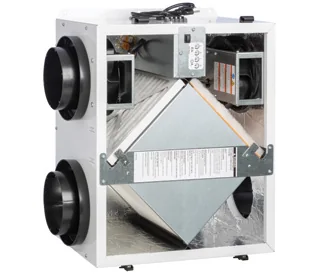
RenewAire Aeri MT (ET-255MF-P340-XC0)
Energy recovery ventilator (ERV). Moves heat and some moisture between the outgoing and incoming air, so dry winter air keeps more of the home’s humidity and humid summer air brings in less.
- Fresh air in, from outside
- Fresh air out, to the rooms
- Stale air in, from the rooms
- Stale air out, to outside
Our drawing, measured from RenewAire Aeri MT dimension drawing, ET-255MF-P340-XC0 (JAN25) (top and front views) to about half an inch: 32 in wide (32 5/8 in overall), 24 3/8 in high (26 1/2 in to the top of the collars), 12 3/4 in deep; two 6 in round and two 6 in-equivalent oval collars on top. The numbers are ours, the same on every unit.
- 231 cfmFresh air at 0.5 in. of duct pressure
- 239 cfmAt 0.4 in., HVI’s rating point
- 63–73%Heat recovery at 32°F (SRE)
- 37–194 WFan power at 32°F
At a glance
- In its favour: HVI-certified (HVI 2005351)Its airflow and efficiency were tested to the Home Ventilating Institute’s standard.
- Plain fact: 239 cfm at 0.4 in., 231 cfm at 0.5 in. of duct pressureCertified fresh air delivered, at HVI’s headline rating point and at the higher pressure many real ducts run at.
- In its favour: RenewAire’s own CO2 control (CO2-W or CO2-D) is listed for the Aeri MTIts manual says the sensor can run the unit or trigger Boost, and a switch between its 24VAC and HIGH terminals runs boost while it stays closed. Set it to 750.
- Plain fact: How it handles frost in very cold weatherNo defrost cycle. The Aeri brochure says the unit needs no frost protection or condensate pans. RenewAire's frost policy says its plate cores work without condensing or frosting when it is warmer than -10°F outside and indoor humidity is below 40%. For harsher conditions RenewAire points to standard defrost methods; an RH series electric duct heater (1-8 kW, indoor ductwork only) is listed as an optional accessory.
Certifications
HVI certified
HVI 2005351
The Home Ventilating Institute tested its airflow and heat recovery. The certified numbers on this page come from its directory. Find HVI 2005351 in HVI’s directory
ENERGY STAR (Canada)
Not on the list
Not on Natural Resources Canada’s ENERGY STAR list when we checked. ENERGY STAR certifies HRVs and ERVs only in Canada, so a unit sold in the U.S. may never have been submitted; that isn’t a sign it’s less efficient. Its HVI numbers show its heat recovery and fan power. NRCan’s ENERGY STAR list (checked October 19, 2026)
Would it cover your home?
Tell it who sleeps in each bedroom. It’s checked against the 800 ppm goal the same way the app checks a unit an installer quotes.
Certified airflow
How much fresh air it delivers as the ducts push back. More duct pressure, less air: that’s why the installer’s duct design matters as much as the unit.
Every certified point
| Duct pressure (in. w.g.) | Fresh air delivered (cfm) |
|---|---|
| 0.1 | 263 |
| 0.2 | 256 |
| 0.3 | 248 |
| 0.4 | 239 |
| 0.5 | 231 |
| 0.6 | 225 |
| 0.7 | 216 |
| 0.8 | 208 |
| 0.9 | 199 |
| 1.0 | 191 |
- Lowest steady airflow (maker)
- 35 cfm
- Highest airflow (maker)
- 255 cfm
Heat and moisture recovery
Sensible recovery (SRE) is the share of heat kept in winter, after the fan’s own heat is taken out; total recovery (TRE) counts moisture too, in summer.
| Outdoors | Airflow | Recovery | Fan power | cfm per watt |
|---|---|---|---|---|
| 32°F (0°C) | 78 cfm | 73% SRE | 37 W | 2.1 |
| 32°F (0°C) | 106 cfm | 70% SRE | 61 W | 1.7 |
| 32°F (0°C) | 176 cfm | 65% SRE | 145 W | 1.2 |
| 32°F (0°C) | 201 cfm | 63% SRE | 194 W | 1 |
| 95°F (35°C), cooling | 81 cfm | 56% TRE | 47 W | – |
| 95°F (35°C), cooling | 112 cfm | 50% TRE | 68 W | – |
| 95°F (35°C), cooling | 176 cfm | 41% TRE | 169 W | – |
| 95°F (35°C), cooling | 201 cfm | 37% TRE | 233 W | – |
- Plain fact: Keeps 63–73% of the heat at 32°FAcross the airflows HVI tested.
- Not stated by the maker: No very-cold (−13°F) test in the HVI directory
- Plain fact: Total recovery in summer: 37–56% at 95°FThe share of heat and moisture kept out on a hot, humid day.
Turning up on CO2
A CO2 control can switch it to a higher speed when the bedroom needs air, then back. HouseExhale’s setting: up at 750 ppm, back at 650, never above 800.
- In its favour: RenewAire’s own CO2 control (CO2-W or CO2-D) is listed for the Aeri MTIts manual says the sensor can run the unit or trigger Boost, and a switch between its 24VAC and HIGH terminals runs boost while it stays closed. Set it to 750.
What RenewAire documents
- In its favour: Its own CO2 control: CO2-W (wall) or CO2-D (duct)A relay that runs the unit on high above its trip point. Documented for the EV90, EV130, EV200, EV Premium and EV Premium+.
- In its favour: The trip point can be set from 500 to 1,500 ppmSo 750 is fine. The gap before it switches back can be 25 to 200 ppm. The factory setting isn’t published: check it.
- Plain fact: EV Premium: a contact between 24VAC and HIGH runs it on highWhen CO2 drops it goes back to normal, or turns off if it was installed that way. Ask for normal.
- Worth knowing: EV90 and EV130: unpowered controls onlyNever connect power to their control terminals. On these the contact may switch the unit on and off, not up: ask.
Four ways to make it turn up by itself
Its maker’s CO2 controlMade for it
RenewAire’s CO2-W or CO2-D, set to switch at 750 ppm, with the unit staying on its normal speed below that.
A CO2 control on its high-speed inputAsk your installer
Its HIGH terminal takes an external control; RenewAire’s own sensor is the documented one.
A night scheduleAsk your installer
A timer on the HIGH input, or its touchscreen control on the EV Premium+.
Your monitor and a smart-home relayAsk your maker first
A dry-contact relay on the same HIGH input. Not documented by RenewAire.
Installing it
The maker’s facts an installer plans around. Your installer confirms them for your home.
- Power
- 120 V, 60 Hz, single phase, 3.6 A (manual). Submittal: 130 W, 1.8 A per motor, 15 A circuit; it also lists 22 to 160 W across the five airflow settings. Comes with a 34 in plug-in cord and needs a grounded 120 V outlet nearby.
- Duct connections
- Four duct connections on top, with pre-installed Snap-N-Go collars for flexible duct: two 6 in round collars for the outdoor-air and return inlets, and two oval collars equal to 6 in for the supply and exhaust outlets. All four ducts point up. Every duct run must be at least 40 in long.
- Size
- 26 1/2 in high x 32 5/8 in wide x 13 3/4 in deep
- Weight
- 25 lb (30 lb maximum in its shipping carton, 34 x 14.5 x 30 in). The cabinet is EPP foam.
- Mounting
- Upright only, per the manual and spec sheet: hung on a wall (across two studs, or a 3/4 in plywood panel on two studs), hung from joists on chains, or set on the floor or a shelf on its feet. Leave at least 18 in for wiring and control access; a floor install needs at least 51 in of total height. The submittal instead says "Can be mounted in any orientation" (see notes).
- Drain line
- No drain line needed: the product page says "No condensate drain required."
- Cold weather
- No defrost cycle. The Aeri brochure says the unit needs no frost protection or condensate pans. RenewAire's frost policy says its plate cores work without condensing or frosting when it is warmer than -10°F outside and indoor humidity is below 40%. For harsher conditions RenewAire points to standard defrost methods; an RH series electric duct heater (1-8 kW, indoor ductwork only) is listed as an optional accessory.
- Balancing the airflow
- Five smart constant-volume airflow setpoints
- Ducts
- Dedicated; verify IOM for central-HVAC integration
- In the box
- The unit with four snap-in collars (two 6 in round, two 6 in-equivalent oval), a 34 in power cord, two MERV 8 filters, and a unit bracket/cleat. Support chains, S-hooks and vibration isolators are not included.Scope: the chain and S-hook exclusions are from the Aeri MT spec sheet and manual
Controls
- Comes with: On-board digital controller with five preset constant-airflow settings (35, 70, 110, 150, 190 CFM, held between 0.2 and 0.6 in. w.g.) plus Dial-A-Flow dials for a low (continuous) and a high/boost speed.
- Wall controls sold: Same accessory list as the EV Premium: TC7D-W / TC7D-E time clock; CO2-W / CO2-D CO2 sensors; IAQ-W / IAQ-D VOC sensors; MC-C / MC-W occupancy sensors; PBT push-button boost timer; PTL percentage timer; FM percentage timer with furnace interlock; PBL push buttons (PTL required); BACNETFC-W BACnet fan control. Only one master control (PTL, FM or PBT); up to six PBL.
- Boost: PBT runs the unit for 20, 40 or 60 minutes. PTL runs it from 10% (6 minutes each hour) up to 100%. A switch between the 24VAC and HIGH terminals runs boost for as long as it stays closed.
- App or smart home: None found in RenewAire documents.
- High-speed input: Low-voltage terminal strip: 24VAC, HIGH, COM, DAMPER, DOOR KILL.
- Humidity control
- Not confirmed
- Bathroom boost
- Not confirmed
- Works without the internet
- Documented
- CO2 inputs
- Dry-contact input
Owning it
- Equipment price
- Not stated in the sources we found
- Rebates
- Federal tax credits ended for work after 2025. Some states and utilities still pay toward an HRV or ERV: rebates by state.
- Filters
- Type: One spun-polyester filter in the outdoor air and one in the return air (the manual calls them mesh-type anti-microbial filters). An optional pleated MERV 13 for the outdoor air side ships loose.
- MERV: MERV 8 standard; MERV 13 optional (outdoor air side only)
- Size: 10 1/2 x 10 1/2 x 1 in (two)
- How often: Manual: replace both filters every 3 months, or more often if needed; don't clean them.
- Warranty
- Core: 10 years (structural and performance) on the plate core. The warranty statement says that in years 3 to 10 a defective core is repaired or replaced at no charge, labor not included.
- Parts: 5-year unit warranty. The statement says five years from the date of manufacture.
- Motor: No separate motor warranty is stated.
- Labor: Not covered ("THIS WARRANTY DOES NOT INCLUDE LABOR").
- Conditions: The unit must be installed and run per RenewAire's instructions and maintained. Keep proof of the installation date; without it, coverage starts 30 days after manufacture. Registration is not required. Damage from improper installation voids it (Aeri manual).
- Sound
- RenewAire publishes sound power (how much sound the unit gives off), not a sones rating, from its own tests (AHRI 230/260, ISO 9614). Cabinet: 30 dBA at 35 CFM, 47 dBA at 150 CFM, 53 dBA at 255 CFM. At a room supply outlet fed by 5 ft of insulated flex duct: 27, 45 and 54 dBA at 35, 150 and 255 CFM. At a room return fed by 5 ft of flex: 26, 40 and 45 dBA. These are not loudness at a set distance.
- Availability
- Active (the only model on RenewAire's Aeri series page)
RenewAire’s page for the ET-255MF-P340-XC0 (opens in a new tab)
Not known yet
What we couldn’t confirm from the maker or HVI. Ask the installer, and get it in writing with the quote.
- How it protects itself from frost in very cold weather
- Exactly how it responds to a CO2 control
- A current equipment price
Where the maker’s own documents disagree
- Mounting: the Aeri MT submittal says "Can be mounted in any orientation", but the manual, spec sheet (09/25) and brochure (05/26) say upright only (wall, floor/shelf, or chain-hung).
- Power conflict inside the submittal: the electrical table says 130 W, but the setpoint table lists up to 160 W. The manual gives 3.6 A.
Other sizes and similar units
Other ERVs with similar airflow
Panasonic BalancedHome Elite Plus+ 210 (FV-21VEC1S)
ERV · HVI 2005488
210 cfm at 0.5 in.
RenewAire EV Premium M
ERV · HVI 2004872
210 cfm at 0.5 in.
S&P TReN200
ERV · HVI 2005459
210 cfm at 0.5 in.
Sources
- Home Ventilating Institute: Section III HRV/ERV complete product listing
- Home Ventilating Institute: Section III HRV/ERV airflow ratings
- Home Ventilating Institute: Section III HRV/ERV energy ratings
- RenewAire: Aeri MT residential ERV
- RenewAire: Aeri MT submittal (CO2-W and CO2-D listed as accessories)
- Natural Resources Canada: ENERGY STAR heat/energy recovery ventilators: searchable product list (216 models on October 19, 2026)
- Aeri MT dimension drawing (JAN25)
- Aeri Series installation and operation manual 115023_001_JAN26
- Aeri ERV Airflow Balancing Manual (164134_000_DEC25)
- Aeri MT ERV flyer / spec sheet (09/25)
- Aeri Series ERV Brochure (LIT175_02, 05/26)
- RenewAire Residential ERVs Sound Data
- RenewAire Limited Warranty statement (form 134766_004)
- Aeri™ Series (RenewAire)
- RenewAire: CO2 sensor wiring supplement (Feb 2026)
- RenewAire: CO2-W / CO2-D specification sheet
- RenewAire: EV Premium manual (Nov 2025)
- RenewAire: EV130/EV200 manual (Apr 2024)
Certified airflow and efficiency from the HVI directory (exported September 23, 2026), joined to this exact model by its HVI number. The maker’s facts from our review of August 31, 2026 and our research of October 17, 2026. This is product information, not a design: your installer confirms the ducts, room-by-room airflow and controls, then measures the airflow after install.
Thinking about a system?
Measure your bedrooms first. When installers quote, the app checks the exact unit they propose, this one or any HVI-certified unit, against what your bedrooms need.