ERVPanasonic Intelli-Balance 200HVI 2004772
Panasonic Intelli-Balance 200 (FV-20VEC1)
Energy recovery ventilator (ERV). Moves heat and some moisture between the outgoing and incoming air, so dry winter air keeps more of the home’s humidity and humid summer air brings in less.
- ENERGY STAR (Canada)
About $3,135Equipment only, at SupplyHouse, October 2026. Installed cost is more.
- Fresh air in, from outside
- Fresh air out, to the rooms
- Stale air in, from the rooms
- Stale air out, to outside
Our drawing, measured from Panasonic FV-20VEC1 Installation and Operating Instructions (December 2025), "Dimensions" (page 5) to about half an inch: 30 3/4 in wide, 27 3/4 in high, 19 1/2 in deep; four 6 in collars on top, a pair at each end. The collars can turn to point sideways; they’re drawn pointing up. The numbers are ours, the same on every unit.
- 182 cfmFresh air at 0.5 in. of duct pressure
- 201 cfmAt 0.4 in., HVI’s rating point
- 73–83%Heat recovery at 32°F (SRE)
- 22–92 WFan power at 32°F
At a glance
- In its favour: HVI-certified (HVI 2004772)Its airflow and efficiency were tested to the Home Ventilating Institute’s standard.
- Plain fact: 201 cfm at 0.4 in., 182 cfm at 0.5 in. of duct pressureCertified fresh air delivered, at HVI’s headline rating point and at the higher pressure many real ducts run at.
- Not stated by the maker: No Panasonic CO2 controlIts wall control’s boost button runs 10 to 60 minutes; its guide mentions no input for an outside control. Ask your installer.
- Plain fact: How it handles frost in very cold weatherBuilt-in frost prevention mode. The defrost cycle starts when the outdoor temperature drops to 14°F (-10°C), using built-in dampers on the outdoor-exhaust and supply ducts. The documents opened don't say how it defrosts or for how long. Panasonic calls it suitable for any North American climate zone.
Certifications
HVI certified
HVI 2004772
The Home Ventilating Institute tested its airflow and heat recovery. The certified numbers on this page come from its directory. Find HVI 2004772 in HVI’s directory
ENERGY STAR (Canada)
Listed as FV-20VEC1
On Natural Resources Canada’s ENERGY STAR list for HRVs and ERVs, which sets minimums for heat recovery in cold weather and for fan power. ENERGY STAR certifies HRVs and ERVs only in Canada. NRCan’s ENERGY STAR list (search the model number) (checked October 19, 2026)
Would it cover your home?
Tell it who sleeps in each bedroom. It’s checked against the 800 ppm goal the same way the app checks a unit an installer quotes.
Certified airflow
How much fresh air it delivers as the ducts push back. More duct pressure, less air: that’s why the installer’s duct design matters as much as the unit.
Every certified point
| Duct pressure (in. w.g.) | Fresh air delivered (cfm) |
|---|---|
| 0.1 | 201 |
| 0.2 | 201 |
| 0.3 | 201 |
| 0.4 | 201 |
| 0.5 | 182 |
| 0.6 | 167 |
| 0.7 | 144 |
| 0.8 | 102 |
| 0.9 | 72 |
| 1.0 | 28 |
- Lowest steady airflow (maker)
- 60 cfm
- Highest airflow (maker)
- 200 cfm
Heat and moisture recovery
Sensible recovery (SRE) is the share of heat kept in winter, after the fan’s own heat is taken out; total recovery (TRE) counts moisture too, in summer.
| Outdoors | Airflow | Recovery | Fan power | cfm per watt |
|---|---|---|---|---|
| 32°F (0°C) | 68 cfm | 83% SRE | 22 W | – |
| 32°F (0°C) | 125 cfm | 77% SRE | 46 W | – |
| 32°F (0°C) | 170 cfm | 73% SRE | 92 W | – |
| -13°F (-25°C) | 66 cfm | 67% SRE | 46 W | – |
| -13°F (-25°C) | 106 cfm | 61% SRE | 104 W | – |
| 95°F (35°C), cooling | 72 cfm | 70% TRE | 25 W | – |
| 95°F (35°C), cooling | 136 cfm | 61% TRE | 56 W | – |
- Plain fact: Keeps 73–83% of the heat at 32°FAcross the airflows HVI tested.
- In its favour: Tested at −13°F too: 61–67% SREHVI’s very-cold test point, useful in cold climates.
- Plain fact: Total recovery in summer: 61–70% at 95°FThe share of heat and moisture kept out on a hot, humid day.
Turning up on CO2
A CO2 control can switch it to a higher speed when the bedroom needs air, then back. HouseExhale’s setting: up at 750 ppm, back at 650, never above 800.
- Not stated by the maker: No Panasonic CO2 controlIts wall control’s boost button runs 10 to 60 minutes; its guide mentions no input for an outside control. Ask your installer.
What Panasonic documents
- Not stated by the maker: No Panasonic CO2 controlIts Swidget smart controls can boost on their own sensors’ readings, but those list VOCs and air quality, not true CO2.
- In its favour: Intelli-Balance Elite and BalancedHome: a dry-contact boost inputTerminals BST and GND; up to two boost switches. The manual doesn’t say if boost holds while closed.
- Worth knowing: Intelli-Balance 100 (FV-10VEC2): its boost switch is 120 VA low-voltage CO2 relay isn’t made for that. Ask an electrician.
- Plain fact: The Swidget Wi-Fi module can schedule boostFor the Elite and BalancedHome models.
Four ways to make it turn up by itself
A night scheduleDocumented
Swidget’s Wi-Fi module schedules boost on Elite and BalancedHome models.
A CO2 control on its high-speed inputAsk your installer
Elite and BalancedHome take a dry contact on BST. The Intelli-Balance 100’s boost is 120 V: an electrician’s job.
Your monitor and a smart-home relayAsk your maker first
A dry-contact relay on BST, on Elite and BalancedHome models only. Not documented by Panasonic.
Its maker’s CO2 controlNot for this unit
Panasonic doesn’t make a CO2 control.
Installing it
The maker’s facts an installer plans around. Your installer confirms them for your home.
- Power
- 120 V, 60 Hz. Uses up to 129 W at 200 CFM and 0.4 in. w.g. Panasonic calls it the corded model; amps and plug type are not stated.
- Duct connections
- Four built-in, adjustable 6 in round duct adapters; the supply and return adapters turn from vertical to horizontal. Insulated 6 in duct is recommended, and static-pressure test ports are included for balancing. Built-in dampers sit on the outdoor-exhaust and supply ducts.Scope: adapter turning from the architectural specification; dampers from spec sheet IAQ21056ST
- Size
- Not stated in the sources we found
- Weight
- 117 lb, as listed by SupplyHouse ('may require a lift gate'). SupplyHouse doesn't say whether this is the unit or the shipping weight; Studio41 lists a shipping weight of 116.8 (no units). No Panasonic document opened states the weight.
- Mounting
- Ceiling, floor or wall. Chain mount and brackets are included: adjustable brackets fix it to a joist at four corners, and a cleat hanger bar gives several wall positions. The bracket fits 16, 19 or 24 in stud bays.Scope: stud-bay spacing from spec sheet IAQ21056ST
- Drain line
- No drain line: Panasonic says no condensate line is needed.
- Cold weather
- Built-in frost prevention mode. The defrost cycle starts when the outdoor temperature drops to 14°F (-10°C), using built-in dampers on the outdoor-exhaust and supply ducts. The documents opened don't say how it defrosts or for how long. Panasonic calls it suitable for any North American climate zone.
- Balancing the airflow
- SmartFlow static-pressure compensation; independent 60-200 CFM supply/exhaust presets
- Ducts
- Ceiling/floor/wall; standalone or central-HVAC; no condensate line
- In the box
- A MERV 13 filter, chain mount and brackets, and a cleat hanger bar for wall mounting.
Controls
- Comes with: Not clear. Panasonic's page marks the Intelli-Balance 200 LCD wall control (nine buttons; shows live airflow and temperature) as 'Required'. SupplyHouse sells the FV-SW20VEC1 wall control separately under 'You May Also Need'.
- Wall controls sold: FV-SW20VEC1 Intelli-Balance 200 LCD wall control. The FV-SCVE2 wall control and WP100PBA Wi-Fi module pages do not list FV-20VEC1.
- Boost: Boost from the wall control: supply and exhaust run at a constant 200 CFM on a timer you can set from 10 to 60 minutes. The CO2 research found the wall control's default is 20 minutes.
- App or smart home: None found. The installation manual's contents list a 'COSMOS communication module', but its pages weren't readable.
- High-speed input: No external boost input is described in the sources opened. Forum posts (secondary) say boost uses a switched 120 V signal.
- Humidity control
- Not confirmed
- Bathroom boost
- Documented
- Works without the internet
- Documented
Owning it
- Equipment price
- $3,134.99 at SupplyHouse, October 17, 2026One price shown, not marked as a sale; in stock (42 units). Wall control sold separately.
- $3,134.99 at Studio41 (on sale), October 17, 2026Shown as a sale from a $4,347.00 regular price; special order / pre-order.
- Rebates
- Federal tax credits ended for work after 2025. Some states and utilities still pay toward an HRV or ERV: rebates by state.
- Filters
- Type: Supply and exhaust filters (the count isn't stated)
- MERV: MERV 13 included; MERV 8 and HEPA replacements available
- Part: FV-FL1320VE1 (MERV 13), FV-FL0820VE1 (MERV 8), FV-FLHP20VE1 (HEPA)
- How often: The wall control shows a filter-maintenance reminder; no interval is stated.
- Warranty
- Parts: 3 years from the original purchase date for all other parts
- Motor: 6 years from the original purchase date on the ECM motors
- Sound
- Not stated in the sources we found
- Availability
- Active (Panasonic US product page live, not on Panasonic's Discontinued Models list; in stock at SupplyHouse). It is not on Panasonic's newer Intelli-Balance series page or the Panasonic Canada Intelli-Balance page.
Not known yet
What we couldn’t confirm from the maker or HVI. Ask the installer, and get it in writing with the quote.
- A CO2 control documented for this exact model
- Its size
- How loud it is
Where the maker’s own documents disagree
- Power: SupplyHouse lists 64 W; Panasonic's page and spec sheet give 129 W at 200 CFM and 0.4 in. w.g.
Other sizes and similar units
Other ERVs with similar airflow
Broan AI Series B210E75RS
ERV · HVI 2004939
201 cfm at 0.5 in.
Venmar AI Series V210E75RS
ERV · HVI 2005175
201 cfm at 0.5 in.
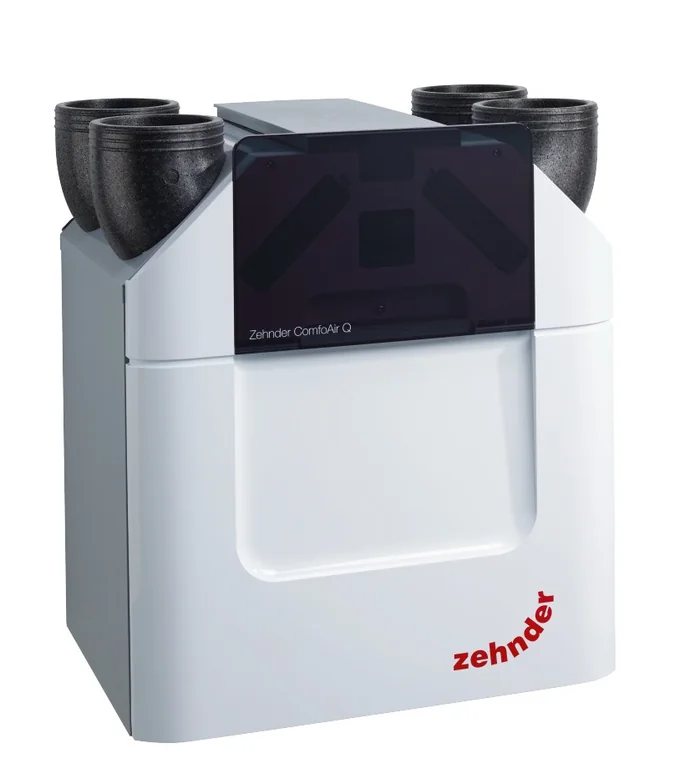
Zehnder ComfoAir Q350 ERV
ERV · HVI 2005163
201 cfm at 0.5 in.
Sources
- Home Ventilating Institute: Section III HRV/ERV complete product listing
- Home Ventilating Institute: Section III HRV/ERV airflow ratings
- Home Ventilating Institute: Section III HRV/ERV energy ratings
- Panasonic: Intelli-Balance 200 Any Climate ERV
- The Home Depot: FV-20VEC1 observed retail listing
- Natural Resources Canada: ENERGY STAR heat/energy recovery ventilators: searchable product list (216 models on October 19, 2026)
- FV-20VEC1 Energy Recovery Ventilator spec sheet IAQ21056ST (Lowe's copy)
- FV-20VEC1 Architectural Specifications (third-party copy)
- Installation and Operating Instructions, ERV FV-20VEC1 (Panasonic Canada; only cover and contents readable)
- FV-20VEC1 Submittal Sheet (Panasonic FTP; not opened)
- FV-20VEC1 Installation Manual, English (Panasonic FTP; not opened)
- Wall Control Installation and Operation Instructions, English (Panasonic FTP; not opened)
- Panasonic Intelli-Balance 200 ERV, FV-20VEC1 (SupplyHouse)
- Studio41: listing
- Panasonic: Intelli-Balance Elite manual (Jun 2025)
- Panasonic: BalancedHome manual (Feb 2025)
- Panasonic: Intelli-Balance 100 (FV-10VEC2) manual (Jan 2024)
- Panasonic: ERV FAQs
- Swidget: which ERV actions can be automated or scheduled
Certified airflow and efficiency from the HVI directory (exported September 23, 2026), joined to this exact model by its HVI number. The maker’s facts from our review of August 31, 2026 and our research of October 17, 2026. This is product information, not a design: your installer confirms the ducts, room-by-room airflow and controls, then measures the airflow after install.
Thinking about a system?
Measure your bedrooms first. When installers quote, the app checks the exact unit they propose, this one or any HVI-certified unit, against what your bedrooms need.