Made by the ventilator’s makerFantech
Fantech CO2RT-R (item 99315)
A Regin-made CO2 controller Fantech sells with its commercial units. Its switch point isn’t published.
$387 at SupplyHouse (October 17, 2026)
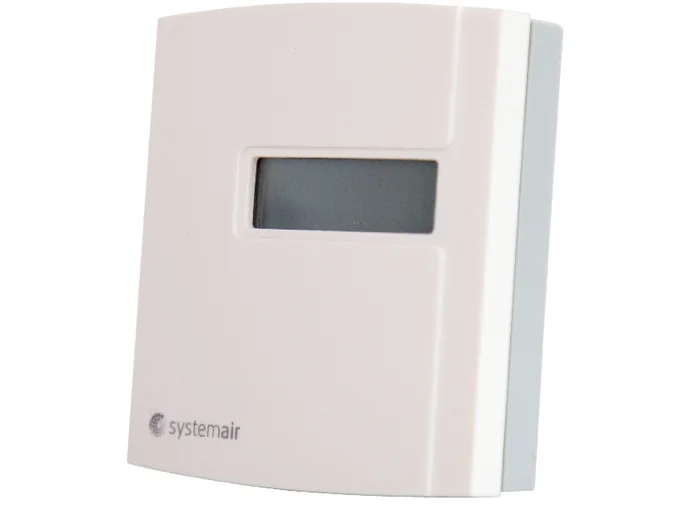
Photo: Fantech
- Setting range not publishedUnder HouseExhale’s 800 ppm goal
- Wall CO2 controller with a relayWhat it is
- An installerWho fits it
At a glance
- Not stated by the maker: Setting range not published
- Plain fact: Switches the unit to high speed above its set pointA relay with normally open and normally closed contacts.
- Not stated by the maker: Its set-point range and factory setting aren’t publishedSo we can’t confirm it can be set to 750. Ask Fantech before buying.
- Worth knowing: Fantech doesn’t show it wired to a home unitIt’s sold with commercial units, “for a single area such as a conference room”. Fantech’s 2022 product card for the HERO 200H lists it as an accessory, but no Fantech document shows the wiring.
- Worth knowing: Self-calibrates, with no off switch documentedIn a bedroom that never airs out, that can pull its readings low.
- Worth knowing: Regin lists it as discontinued
Regin, its maker, lists it as discontinued.
Setting it for a bedroom
HouseExhale’s setting: switch up at 750 ppm and back at 650, or ramp from 600 to full by 750. Never above 800.
- Ask Fantech for its set-point range first. If it can be set to 750 ppm, set it there; if it can’t go below 800, it won’t meet the goal.
A Danish study ran a bedroom fan from about 900 ppm and the nights still averaged 835, so a control has to start below the goal. Good home CO2 sensors are rated within about 55 to 90 ppm at 800, and the night average includes the climb after bedtime, so 750 on and 650 off leaves room for both. A control in the return duct mixes the bedroom with empty rooms, so it needs lower settings still (about 650 on, 550 off), and your monitor in the bedroom has the final word. These are HouseExhale’s numbers: no study has tested a control against an 800 night average yet.
What it works with
Its maker’s own units, as its manual says.
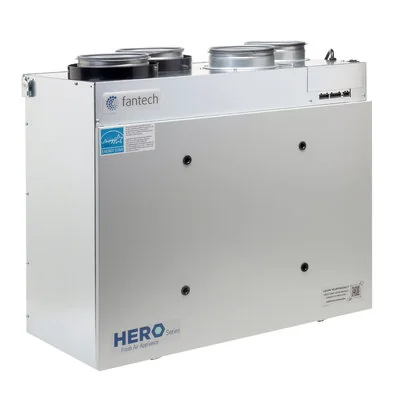
Fantech HERO 200H
Listed as an accessory; wiring not documented
195 cfm at 0.5 in.
Specs
- Sensor
- True CO2 (NDIR), 0–2,000 ppm
- Relay
- 50 V AC or 60 V DC, 1 A; terminals 3 (common), 4 (normally open), 5 (normally closed)
- Power
- 24 V AC, or 15–35 V DC (3 W)
- Mounting
- Wall or wall box
From the maker’s documents, read October 17, 2026. Prices are before tax and shipping and change often.
Made by the ventilator’s maker
Sold for a maker’s own units, with the wiring in its manuals. An installer fits them.
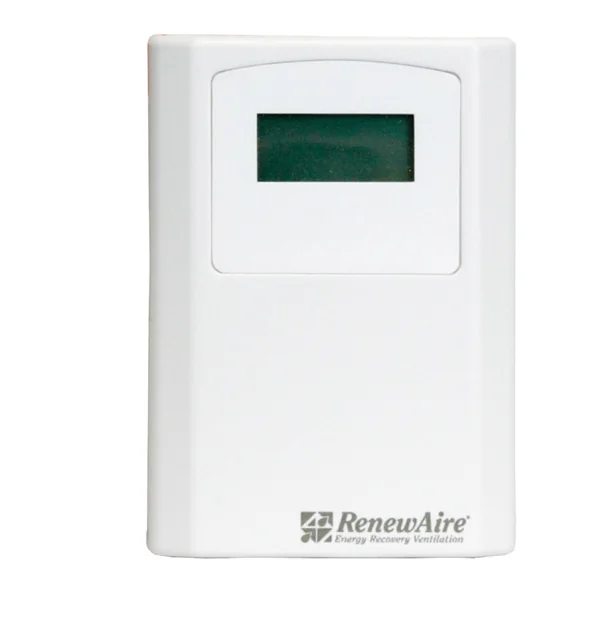
RenewAire CO2-W (wall) and CO2-D (duct)
Can be set under 800
CO2 controller with a relay, for RenewAire ERVs
S&P SCO2-W
Can be set under 800
Wall CO2 control for S&P ventilators
Zehnder CO2 sensor (0–10 V) with the Option Box
Can be set under 800
Wall CO2 sensor for ComfoAir units