Works by typing one number a day
Airthings View Plus
Measures radon and particles too, on batteries or USB, with up to a year of history to export.
About $330checked October 2026
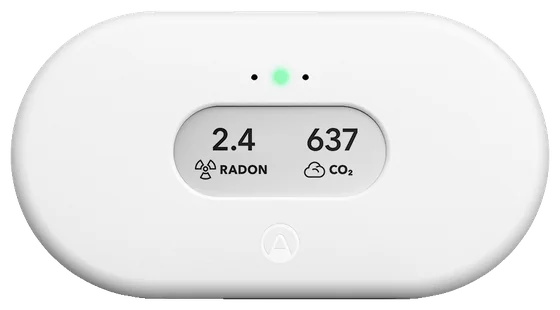
Photo: Airthings
- ±(50 ppm + 5%)CO2 accuracy, as the maker states it
- Type one numberHow the night gets into HouseExhale
- On, no off settingSelf-calibration
- BatterySix AA batteries, or USB
At a glance
- In its favour: Import whole nights from its CSV
- In its favour: Six AA batteries, or USB
- Worth knowing: Self-calibration on; no off setting found
- Not stated by the maker: Altitude correction not stated
With HouseExhale
The app looks at your bedroom’s CO2 across the night and checks it against the 800 ppm goal. Here’s how this monitor’s nights get in.
On Android, iPhone or in a browser
- Each morning, type the night’s high from the Airthings app, or import its CSV.
Finding last night’s high
Open the Airthings app each morning and look at last night’s CO2 history. Note the highest point while people were asleep, and type it in the app.
Its export is a CSV the app can import, so you can bring in whole nights instead of typing.
Where to put it: about head height, at least 2 ft from anyone’s face, away from windows, doors and vents, and in the same spot every night. More on placement
Calibrating it
- Worth knowing: Self-calibration on; no off setting foundOn, with no setting to turn it off (updates weekly; a reviewer found no setting for it)
Outdoor air is about 425 ppm. Outside in the shade, a good monitor settles between about 400 and 450 within 15 to 30 minutes. Many monitors treat fresh air as 400, so 400 to 420 is normal. Can I trust my monitor?
Specs
- Sensor and accuracy
- True CO2 (NDIR), ±(50 ppm + 5%), plus radon and particles
- Self-calibration
- On, with no setting to turn it off (updates weekly; a reviewer found no setting for it)
- Corrects for altitude
- Not stated by the maker
- Also measures
- Radon, particles (PM), VOCs, temperature, humidity and air pressure
- CO2 range
- 400–5,000 ppm
- How often it updates
- CO2 is measured every 5 minutes on batteries and every 2.5 minutes on USB. A reviewer adds that it sends readings to the Airthings cloud every 10 minutes by default (“Latest data” mode), every hour in “Longest battery life” mode, and every 2.5 minutes on USB.
- Power
- Six AA batteries (up to 2 years) or USB-C
- Screen
- 2.9-inch e-paper
- History
- Wi-Fi; the web dashboard exports up to a year as a CSV
- App
- Airthings app (free) for iPhone and Android (one of the three latest major versions, with Bluetooth 4.2 or later)
- Exports a CSV
- Yes
- Connects by
- Wi-Fi (2.4 GHz), Bluetooth LE and Airthings SmartLink. Readings go through Airthings’ cloud; a reviewer found no way to read it locally.
- Alarm
- No sound alarm mentioned. A red, yellow or green glow shows air quality. A reviewer says levels and notifications can be adjusted in the Airthings app, and gives Airthings’ CO2 levels as green below 800 ppm, yellow 800–1,000 and red above 1,000.
- Smart home
- Airthings lists IFTTT, Google Assistant and Amazon Alexa. Home Assistant: the official Airthings integration works through Airthings’ cloud (“Cloud Polling”), with an ID and secret from the Airthings dashboard. Home Assistant’s Bluetooth integration (Airthings BLE) doesn’t list the View Plus. Apple Home and Matter: no, per a comparison site.
- Size
- 17 × 9 × 3.3 cm (6.7 × 3.5 × 1.3 in)
- Weight
- 360 g (12.7 oz) with batteries, without the cable
- Works in
- 4–40 °C (39–104 °F), 0–85% humidity, non-condensing
- In the box
- The monitor, six AA batteries, a USB cable, a quick start and regulatory booklet, and double-sided tape
- Warranty
- 1 year standard (2 years in the EU/EEA). Registering within 30 days of purchase extends it to 5 years in total, for consumer monitors bought after August 1, 2022.
Specs from the maker’s own pages, checked October 12 and October 17, 2026. “Not stated by the maker” means no maker page we could open says.
Turning ventilation up
Home Assistant’s Airthings integration reads it through Airthings’ cloud, not locally, so an automation depends on the internet. Home Assistant: Airthings integration
With a smart-home relay on a ventilator’s high-speed input, that reading can turn an HRV or ERV up at 750 ppm and back down at 650. Through the cloud, it stops when the internet does, so set the relay to switch itself back off. Ventilator makers don’t document this, so check your unit’s manual first, and keep to low-voltage inputs.
Before you buy
- Plain fact: About $330 before tax and shipping$329.99 at Airthings and The Home Depot.
About $330, checked October 2026. Prices change often; we checked at the maker’s store and large US retailers. Any monitor that measures true CO2 works with HouseExhale, and one is enough: move it between rooms.
Compare it
The monitors closest to it in price.
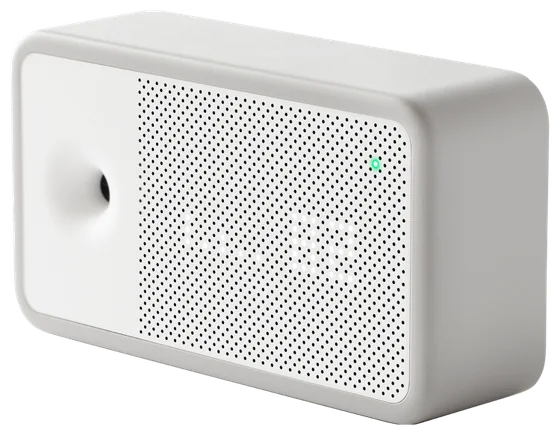
Awair Element
About $299
Shows an air score on the device, and its app exports the last 30 days. Needs a plug.
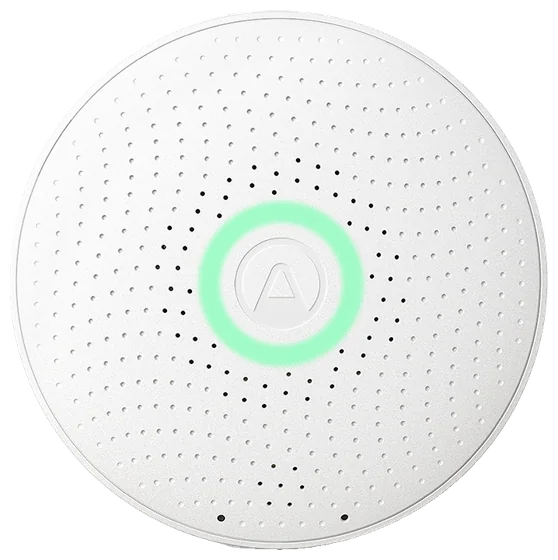
Airthings Wave Plus
About $230–$250
Measures radon too. It has no screen: you read the numbers in the Airthings app.
Sources
- Airthings View Plus
- Airthings View Plus product sheet (accuracy, weekly self-calibration)
- Airthings: exporting dashboard data
- Home Assistant: Airthings integration
- Airthings View Plus product specification (revision V1-06-2021, hosted by The Home Depot)
- raspberry.tips: Airthings View Plus review, Sept 25, 2026
- Airthings help: what the lights on the monitor mean
- Home Assistant: Airthings BLE integration
- Smart Home Compared: Airthings View Plus
- Airthings: extended 5-year warranty coverage
- Airthings Norway: Wave Plus
Already have one?
Set it up in the app tonight. It takes about 5 minutes, and the first answer comes after two or three nights.