Works by typing one number a day
AirGradient ONE
Sends readings over Wi-Fi to a dashboard that exports a CSV, so nothing depends on your phone. Needs a plug.
About $230checked October 2026; check before buying
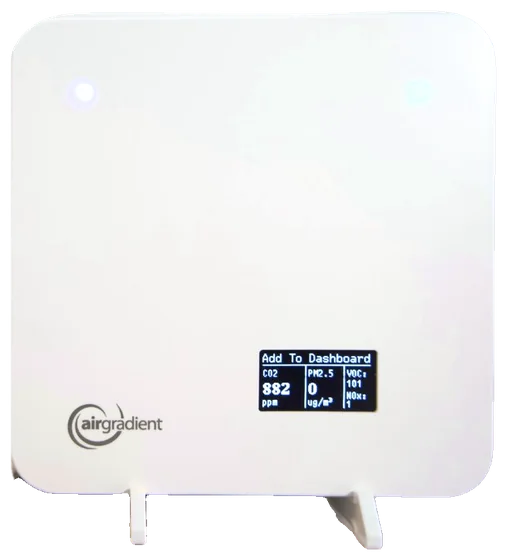
Photo: AirGradient
- ±(40 ppm + 3%)CO2 accuracy, as the maker states it
- Type one numberHow the night gets into HouseExhale
- On; can be turned offSelf-calibration
- Plug it inNeeds a plug (USB-C)
At a glance
- In its favour: Import whole nights from its CSV
- Plain fact: Needs a plug (USB-C)
- Plain fact: Self-calibration on; you can turn it off
- Not stated by the maker: Altitude correction not stated
With HouseExhale
The app looks at your bedroom’s CO2 across the night and checks it against the 800 ppm goal. Here’s how this monitor’s nights get in.
On Android, iPhone or in a browser
- Each morning, type the night’s high from the AirGradient dashboard, or import its CSV.
Finding last night’s high
Open the AirGradient dashboard each morning and look at last night’s CO2 history. Note the highest point while people were asleep, and type it in the app.
Its export is a CSV the app can import, so you can bring in whole nights instead of typing.
Where to put it: about head height, at least 2 ft from anyone’s face, away from windows, doors and vents, and in the same spot every night. More on placement
Calibrating it
- Plain fact: Self-calibration on; you can turn it offOn by default, can be turned off (every 7 days; turn it off in the dashboard under Edit Calibration)
Outdoor air is about 425 ppm. Outside in the shade, a good monitor settles between about 400 and 450 within 15 to 30 minutes. Many monitors treat fresh air as 400, so 400 to 420 is normal. Can I trust my monitor?
Specs
- Model
- I-9PSL
- Sensor and accuracy
- True CO2 (NDIR, Senseair S8), ±(40 ppm + 3%), plus particles and VOCs
- Self-calibration
- On by default, can be turned off (every 7 days; turn it off in the dashboard under Edit Calibration)
- Corrects for altitude
- Not stated by the maker
- Also measures
- PM2.5 (and PM1 and PM10), TVOCs, NOx, temperature and humidity
- CO2 range
- 400–10,000 ppm (Senseair S8)
- How often it updates
- Not stated by the maker
- Power
- USB-C only; bring a 2 A adapter
- Screen
- 1.3-inch OLED
- History
- Sends readings over Wi-Fi to AirGradient’s dashboard, which exports a CSV
- App
- The AirGradient dashboard, on the web. AirGradient’s only App Store listing is “AirGradient Map”; no phone app for the ONE was found.
- Exports a CSV
- Yes
- Connects by
- Wi-Fi (2.4 GHz); the product page also lists Bluetooth LE. A cellular version (I-9PSL-CE) exists. Readings go to AirGradient’s online dashboard. Home Assistant can read it on the home network, and keeps working with the cloud connection off.
- Alarm
- No buzzer mentioned. Eleven colored LEDs on the front show air quality and can be switched off completely; alerts are set up in the dashboard. No default CO2 level given.
- Smart home
- Home Assistant: the official AirGradient integration works locally and finds the monitor by itself (AirGradient says Home Assistant 2024.6 or newer with the latest firmware; HA’s docs say firmware 3.1.1 or newer). It reads CO2 and has a self-calibration (ABC days) setting. No Apple Home, Google, Alexa or Matter support found.
- Size
- Sources disagree: 131.2 × 131.2 × 36.2 mm on the spec sheet; 130 × 130 × 35 mm on the product page
- Weight
- Sources disagree: 230 g without the cable on the spec sheet; 350 g on the product page
- Works in
- Not stated by the maker
- In the box
- The monitor and a 2 m USB-C to USB-A cable. No power plug: bring a 5 V, 2 A USB adapter.
- Warranty
- 12 months for the assembled monitor; the kit has no warranty
Specs from the maker’s own pages, checked October 12 and October 17, 2026. “Not stated by the maker” means no maker page we could open says.
Turning ventilation up
Home Assistant’s AirGradient integration reads its CO2 over your own network (firmware 3.1.1 or later), and keeps working with its cloud connection turned off. Home Assistant: AirGradient integration
With a smart-home relay on a ventilator’s high-speed input, that reading can turn an HRV or ERV up at 750 ppm and back down at 650. Ventilator makers don’t document this, so check your unit’s manual first, and keep to low-voltage inputs.
Before you buy
- Worth knowing: Check the price before buyingWe couldn’t confirm a current store price, or it was out of stock, when we checked.
- Plain fact: About $230 before tax and shippingAssembled; the kit was $138. We couldn’t open AirGradient’s store in October, and it ships from Thailand.
About $230, checked October 2026; check before buying. Prices change often; we checked at the maker’s store and large US retailers. Any monitor that measures true CO2 works with HouseExhale, and one is enough: move it between rooms.
Compare it
The monitors closest to it in price.
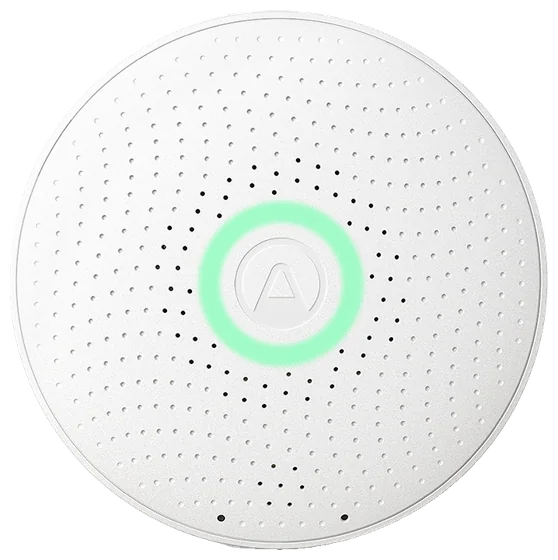
Airthings Wave Plus
About $230–$250
Measures radon too. It has no screen: you read the numbers in the Airthings app.
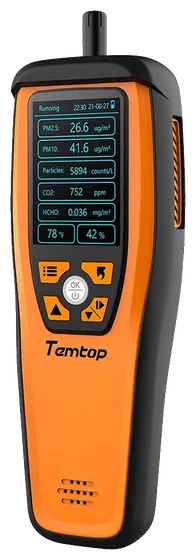
Temtop M2000 2nd
About $190–$210
Shows particles too, with a 24-hour curve on its screen. Plug it in overnight.
Sources
Already have one?
Set it up in the app tonight. It takes about 5 minutes, and the first answer comes after two or three nights.